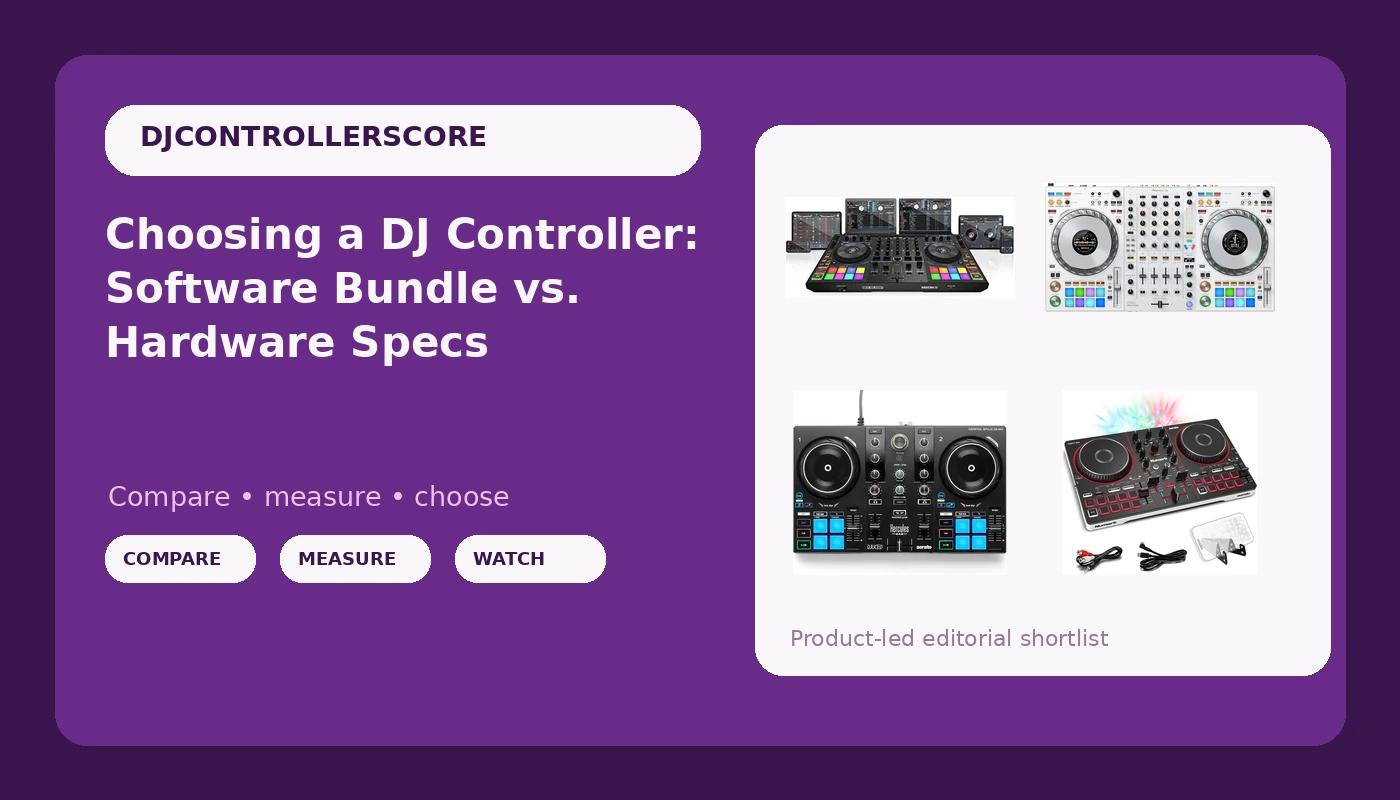
Choosing a DJ controller is mostly a software decision wearing a hardware costume. The four units in this guide look like they belong to four different hobbies: a white four-channel controller with track separation, a black four-channel alternative, a compact beginner unit that ships with Serato Lite, and a Bluetooth controller with built-in lights. The problem for a buyer is that a spec sheet does not rank them against each other, because they are not competing for the same person.
The useful question is not which controller carries the longest feature list. It is which controller matches the software you will actually open every night, and how many channels your sets actually use. Get that order wrong and you either pay for channels you never touch, or you outgrow a two-channel layout within a month. Here is how these four options sort out.
Related: Jog Wheel Feel: What to Check Before You Buy →
Quick answer
Match the controller to the software you are willing to learn, then to the number of channels your sets genuinely use. For a first controller, a compact unit with a bundled Serato Lite license covers practice and small rooms. If your sets involve live edits, acapella layering, or four simultaneous decks, a four-channel controller with track separation features is the more direct path. For casual parties where the music comes from a phone, a Bluetooth controller with built-in lights is a legitimate choice rather than a compromise. None of these four is a universal answer, and none of them replaces practice.
Four useful options
| Model | Best fit | What stands out |
|---|---|---|
| Pioneer DJ DDJ-FLX10 4-Channel DJ Controller, Track Separation, White | Four-channel sets that involve live edits | Four-channel layout and track separation named as a headline feature |
| Reloop Mixon 8 Pro 4-Channel DJ Controller, Black | Four-channel mixing outside the Pioneer DJ ecosystem | Four-channel layout in a black finish from a different brand family |
| Hercules DJControl Inpulse 200 MK3 - Ideal DJ Controller with Serato Lite | First controller and nightly practice | Bundled Serato Lite license and a compact footprint |
| Numark Party Mix III Bluetooth DJ Controller with Built-in Lights | Casual parties and phone-based playback | Bluetooth audio and built-in lights |
The flagship: Pioneer DJ DDJ-FLX10 4-Channel DJ Controller, Track Separation, White
The trade-off here is scope. A four-channel controller asks for a bigger footprint on the desk and a bigger commitment in setup time, and track separation only earns its place if you actually perform with stems. If your sets are two-deck blends and hot cue work, the extra channels sit unused while the hardware takes up the space anyway. The counter-argument is that this is the only unit in the group with track separation written into its name, so if that workflow is central to what you do, the other three options cannot fill that role. Confirm the included software license and the current feature set on the listing before you commit, since bundles and software tiers change.
The alternative: Reloop Mixon 8 Pro 4-Channel DJ Controller, Black
This is the entry in the group where the listing itself does the least talking, and that matters. The verified details are the four-channel layout and the black finish; which software license ships with it, and which software tiers it unlocks, should be confirmed on the current listing rather than assumed. Treat that as your first question, because a four-channel controller paired with a software tier that caps you at two decks is a mismatch you feel on the first night. The honest summary: this is a four-channel option to compare against the flagship, not a like-for-like replacement for it.
The beginner option: Hercules DJControl Inpulse 200 MK3 - Ideal DJ Controller with Serato Lite
Two things to understand before buying. First, "ideal DJ controller with Serato Lite" is manufacturer marketing language, not a measured result, so read it as a description of the bundle rather than a verdict. Second, Serato Lite is the entry tier of the Serato family, and moving up to the full Serato DJ Pro tier is a separate, paid step. That upgrade path is normal, not a trick, but you should price it into your plan if you intend to grow into club-style features. What this controller does well is remove excuses: the software is included, the footprint is small, and nothing about the setup stops you from practicing every night.
The party option: Numark Party Mix III Bluetooth DJ Controller with Built-in Lights
Here is the honest framing: lights are a feature, not a durability signal. A controller can have a great light show and faders that give up after a season of hard use, and the two facts have nothing to do with each other. Bluetooth is the more substantive detail, because it changes how you play: no laptop library required, no cable run to the phone, and a much faster setup for a casual event. What it does not give you is the same level of control as a wired, library-based workflow. If you plan to move into prepared sets and beatmatched transitions, treat this as a starting point or a second controller rather than your only one.
Prices and availability may change. Product images, names, and retailer links are matched to verified listings. No current price, rating, stock status, or measured result is stated here without current evidence.
What the bundled software is actually worth
The software in the box is half the value of the purchase, and it is the part buyers skim past. Serato and rekordbox are the two ecosystems most controllers are built around, and both now operate in tiers. A bundled entry license gets you playing immediately, but it usually comes with limits on decks, effects, or recording, and the step up to the full tier is a paid upgrade. Some feature sets are also moving behind subscription plans rather than one-time purchases, which changes the long-term cost of a controller in a way the hardware price never shows.
So read every bundle as two separate questions. What can I do on day one with the included license, and what does the upgrade cost when I hit the ceiling? A controller with a generous included tier can be the smarter buy than a more expensive controller with a thin one, because you will spend your first year in the software, not staring at the hardware. This is also where resale value lives. Controllers that run on a widely used ecosystem stay useful to the next owner, and that keeps their secondhand value steadier.
How to judge hardware you cannot touch
Specs describe hardware, but they do not describe feel, and feel is what you notice at hour three of a set. The jog wheel is the clearest example: a wheel with no resistance turns every pitch bend into an approximation, and you only discover that when you are trying to nudge a track into alignment in front of people. Channel count is the second. Two channels are enough to learn on and enough for a great many gigs; four channels matter when you genuinely layer tracks, run acapellas, or keep a loop bed running underneath. Buy the channel count you will use, not the one that looks serious on a spec sheet.
Then there is durability. Faders wear out, and the question is never whether they will, only when and where. A crossfader that dies during practice is an inconvenience; one that dies during a paying gig is a different category of problem. Before buying, look at how the unit is built, what replacement parts exist, and how the manufacturer handles support. Finally, verify the boring things on the listing: input and output connections, headphone outputs, whether the bundled software license transfers, and whether the unit needs external power or runs from USB. Those details decide whether the controller fits your setup at all.
- Decide which software ecosystem you are committing to, because it determines which controllers are even candidates.
- Count the channels your sets actually use over a full night, not the channels you might use someday.
- Check what license is included and what the upgrade to the full tier costs.
- Check the physical build, the connections, and whether spare parts and support exist.
- Buy for the setup you will have in eighteen months, not the one you have this week.
Practical setup advice before you buy
- Budget for headphones and cables as part of the purchase, not as an afterthought.
- Plan a practice routine before you plan an upgrade; gear is rarely the bottleneck.
- If you play out, favor hardware with a widely used software ecosystem so you can adapt quickly.
- Keep the original box and packaging, because it makes resale dramatically easier.
- Do not let lights or cosmetic finishes outrank fader quality in your decision.
Which option should you choose?
Choose the Pioneer DJ DDJ-FLX10 4-Channel DJ Controller, Track Separation, White when four-channel sets and track separation are central to how you perform. Choose the Reloop Mixon 8 Pro 4-Channel DJ Controller, Black when you want a four-channel layout from a different brand family and have already confirmed the bundled software on the listing. Choose the Hercules DJControl Inpulse 200 MK3 - Ideal DJ Controller with Serato Lite when you are buying your first controller and want the software question answered in the box. Choose the Numark Party Mix III Bluetooth DJ Controller with Built-in Lights when your events are casual, the music comes from a phone, and Bluetooth plus built-in lights genuinely fit the room.
Nothing here is based on a lab measurement, and no current price, rating, or stock status is stated. Bundles, included licenses, and supported software tiers change between production runs, so verify those details on the live listing before you buy, and confirm the return window in case the layout does not suit your hands.
The bottom line
The right order of operations is software, then channels, then hardware feel. Start with the ecosystem you will actually open every night, decide how many channels your sets use, and only then compare controllers. The Inpulse 200 MK3 answers the software question for a beginner, the Party Mix III fits casual Bluetooth-driven parties, and the two four-channel units, the DDJ-FLX10 and the Mixon 8 Pro, are for players who genuinely use the extra decks. Whichever you pick, the practice hours after the purchase are what decide how good the setup turns out to be.