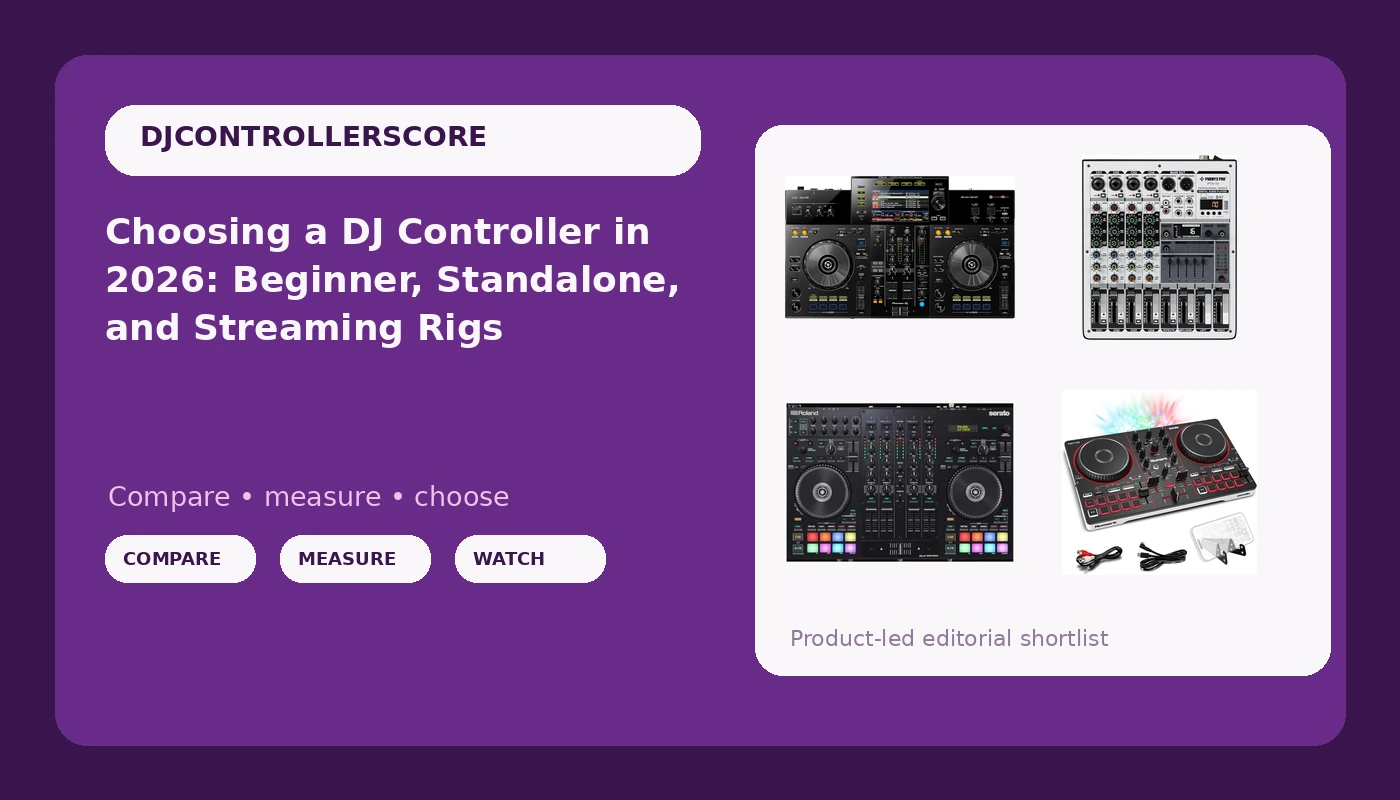
Choosing a DJ controller is the first gear decision most people get wrong, and it almost never goes wrong because of channel count. It goes wrong because of two things the spec sheet buries: the software bundle that comes in the box, and how the platters actually feel under your fingers at hour two of a set. Choosing a DJ controller is really a question about which of those two compromises you can live with for the next two years, because everything else is marketing.
This is not a shootout. The four products below do genuinely different jobs. One is an entry-level deck with lights and Bluetooth. One is a standalone system that does not need a laptop. One is built for people whose sets end up on a stream as often as in a room. And one is not a controller at all, but a mixer that makes sense when you are building a hybrid rig. Match the product to the job and most of the agonizing disappears.
Related: Rekordbox vs Serato: Which Software Bundle Actually Matters →
Quick answer
There is no single winner here, because these four products are not competing for the same slot. The Numark Party Mix III is the entry point of the group, with Bluetooth audio and built-in lights. The Pioneer DJ XDJ-RR is the laptop-free option, part of Pioneer DJ's XDJ standalone family. The Roland DJ-707M is the one explicitly positioned for live streamers and content creators. The Phenyx Pro PTX-15 is a four-channel mixer with a USB audio interface and 16 DSP effects, which makes it a companion for a hybrid rig rather than a controller. Decide the job first, then pick the match.
Four useful options
| Model | Best fit | What stands out |
|---|---|---|
| Numark Party Mix III Bluetooth DJ Controller with Built-in Lights | First controller, casual parties | Bluetooth input and built-in lights |
| Pioneer DJ XDJ-RR Digital DJ System | Laptop-free sets | Standalone system in Pioneer DJ's XDJ line |
| Roland DJ-707M DJ Controller for live streamers and content creators (DJ-707M) | Streamed sets and content | Positioned specifically for streaming and content creation |
| Professional Audio Mixer, Phenyx Pro Sound Console w/USB Audio Interface, 4-Channel Sound board DJ Mixer w/Stereo Equalizer, 16 DSP Effects, suitable for Stage, Live Gigs, and Karaoke (PTX-15) | Hybrid rigs, karaoke, live gigs | Four channels, USB audio interface, 16 DSP effects |
The entry point: Numark Party Mix III Bluetooth DJ Controller with Built-in Lights
The trade-off here is honest and worth saying out loud: Bluetooth and built-in lights tell you who Numark built this for, and that is not a club booth. Party features do not transfer to a room with a proper sound system. What they do is remove friction. If your first question is whether you actually enjoy DJing, a controller that streams from a phone and lights up when the room gets going is a low-commitment way to find out, and it keeps you practicing instead of shopping. My rule for beginners has not changed in eight years: gear is not the bottleneck, practice is. Buy the thing that lets you practice every night, then upgrade when you have outgrown it, because the resale market for starter controllers is healthy.
The laptop-free option: Pioneer DJ XDJ-RR Digital DJ System
The XDJ-RR sits in a different mental category from everything else on this list. A controller is a box of knobs that borrows a laptop's brain. This is a system that stands on its own, which changes how you prepare and how you show up. You are not troubleshooting a driver in a dark room ten minutes before doors. The trade-off is that standalone playing asks more of your library habits up front. The XDJ line also means you are learning on the same layout logic that fills club booths, and if your goal is to eventually play on installed gear, that familiarity is worth more than any feature list. You do not need four channels to be good. You need two solid channels and a brain that plans transitions, which is exactly what this gives you.
The streaming rig: Roland DJ-707M DJ Controller for live streamers and content creators (DJ-707M)
Roland's DJ gear has always been the weird, wonderful corner of the market, and the DJ-707M carries that flag into streaming. The trade-off is focus. A controller engineered around the assumption that someone is listening through a phone speaker and a chat window makes different choices than one engineered for a room. If your sets live online, that framing is a feature. If you are trying to learn beatmatching in a basement, it is decoration. Be honest about which DJ you are, because the two versions of you want different hardware, and this is the one for the version with a webcam.
The companion mixer: Professional Audio Mixer, Phenyx Pro Sound Console w/USB Audio Interface, 4-Channel Sound board DJ Mixer w/Stereo Equalizer, 16 DSP Effects, suitable for Stage, Live Gigs, and Karaoke (PTX-15)
My lane is controllers, so I will be blunt: this is a mixer, and a mixer is not a controller. It has no jog wheels and no platters, which means it cannot be the thing you learn to mix on. It is here because a real number of readers end up running a hybrid rig, with decks or media players feeding a mixer, plus a microphone for a wedding or a karaoke night. If that is the shape of your setup, a four-channel console with a USB audio interface and onboard effects is the piece that ties it together. If it is not, skip this section entirely and spend the money on software you will actually use.
Prices and availability may change. Product images, names, and retailer links must be matched by verified ASIN. Do not state a current price, rating, stock status, or measured result without current evidence.
What the software bundle actually buys you
Every controller is two products: a box of controls and a license to play. The box gets all the attention. The license decides whether you enjoy using it.
What to look at, in order:
- Is the license included or subscription-only? A controller that unlocks a full version of its software is worth more than one that asks you to keep paying for basic features. Software that gates core functionality behind a monthly fee is one of the fastest ways to sour on a controller you otherwise like.
- Which software is it, and does it match the rooms you want to play? Different ecosystems dominate different scenes. If the people who book you work in one, learning that one saves you a painful migration later.
- How good is the library analysis? Beat grids and key detection are not glamorous, but a bad grid means every sync and every loop drifts, and you spend your first hour fighting the software instead of reading the room.
- Can you export your library? Your collection is the asset. If the software makes it painful to move, you are renting your own music back.
- Is the software still being developed? Hardware outlives software support more often than people expect.
There is a resale angle too. Controllers hold value better when the software they unlock is still current. A beginner deck that resells easily when you upgrade is a much smaller commitment than its price tag suggests, because part of that money comes back.
How to judge jog wheels and faders before you buy
Jog wheel feel is the soul of a controller. Close your eyes and touch the platter: that is the review. Cheap plastic wheels with no resistance make every pitch bend feel like a guess, and no amount of feature comparison fixes that. Faders are the other half. They all die eventually; the question is whether they die at a gig or after a few hundred hours in a studio. Nobody can answer that from a spec sheet, so build a decision process that respects what you cannot know in advance.
- Decide whether you are playing from a laptop or from USB media. That single answer eliminates most of the market and probably half this list.
- Read the software bundle before the hardware specs. Check whether the license is included, and whether the unlock covers the features you actually need.
- Match the channel count to your real transitions rather than your imagined ones. Most mixes need two channels and a plan.
- Get hands on the unit if you possibly can, or buy somewhere with a return window, then check jog wheel resistance with your eyes closed and your headphones off.
- If your sets end up online or you always run a microphone, treat audio routing and inputs as first-class features, not afterthoughts.
Practical guidance for your first or next controller
- Budget for the software, not just the box. A cheaper controller that unlocks a full license can cost less over two years than an expensive one that does not.
- Two good channels beat four cheap ones every time. Nobody has ever been booked because of channel count.
- Buy for the set you actually play. Wedding, bedroom, stream, and club are four different jobs, and only one of them involves RGB lights on a controller with soft faders.
- Keep the original packaging and the cable for at least a month. It makes returns and resale dramatically easier.
- If you cannot test a unit in person, buy the return window as carefully as you buy the controller, then run a long session before the window closes.
Which option should you choose?
Choose the Numark Party Mix III Bluetooth DJ Controller with Built-in Lights when you are starting out, want Bluetooth and built-in lights, and mainly need to find out whether DJing sticks. Choose the Pioneer DJ XDJ-RR Digital DJ System when you want to play without a laptop and want to be on familiar club-style ground. Choose the Roland DJ-707M DJ Controller for live streamers and content creators (DJ-707M) when your sets are content first and the broadcast is the performance. Choose the Phenyx Pro PTX-15 when you already have decks or media players feeding a rig and need a four-channel mixer with a USB audio interface and onboard effects.
A caveat worth stating plainly: the distinctions above come from how each product is positioned and named by its manufacturer, not from a lab test I ran on these four units. Input counts, software bundles, and included licenses can change between revisions, so confirm the current details on the listing before you commit. If two options look equal on paper, pick the one whose software you would rather open every night, because that is the decision you will live with.
The bottom line
The controller is not the bottleneck. The bundle and the platters are the two things you will notice every single time you play, and both of them are mostly invisible in a spec table. Start with the job: laptop-free, streaming-first, first-timer, or hybrid mixer rig. Then read the software situation carefully, get your hands on the platters if you can, and buy the option that lets you practice every night instead of the one that looks best in a photo. Gear does not fix bad transitions, but the wrong gear absolutely makes good transitions harder to learn.