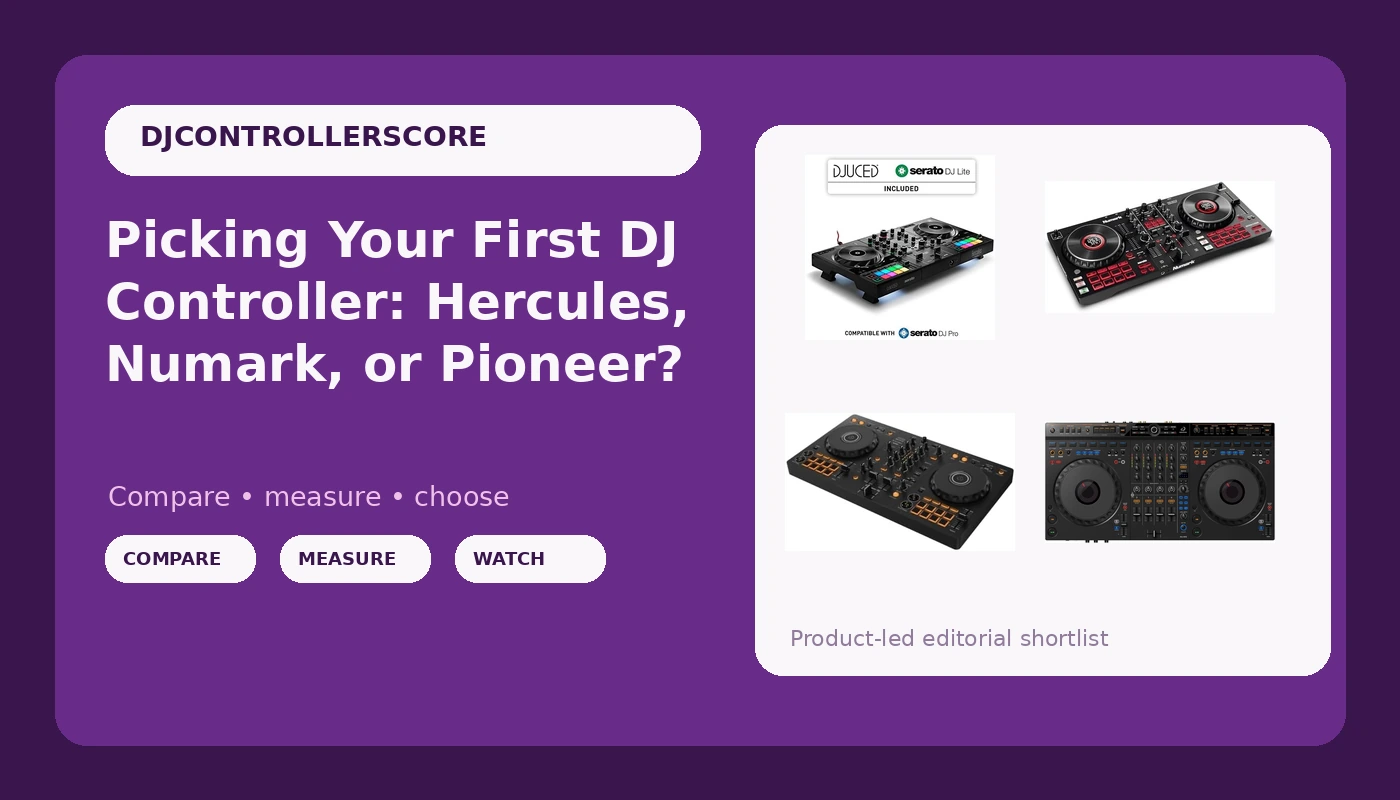
Buying a first DJ controller is mostly a software decision wearing a hardware costume. The four options here, the Pioneer DJ DDJ-FLX4, the Hercules DJControl Inpulse 500, the Numark Mixtrack Platinum FX, and the AlphaTheta DDJ-GRV6, all do the same basic job: they put two or four decks of digital audio under your hands. What separates them is the software bundle that comes in the box, the number of channels on the surface, and how the jog wheels and faders feel after the novelty wears off. This is not a ranking, and it is not a race to the top of the price ladder. It is an explainer on what each controller is actually for, so the money you spend on a first DJ controller goes toward practice rather than features you will not touch for a year.
Related: How to Choose Your First DJ Controller →
Quick answer
The decision usually narrows to two questions: how many channels do you need right now, and which software do you want to learn on? A 2-channel controller is enough for beatmatching, phrasing, and building transitions. A 4-channel controller only pays off once you are layering loops, running acapellas, or feeding live hardware into the mix. On software, the Hercules DJControl Inpulse 500 is listed as compatible with both Serato and DJUCED, so that choice stays open, while the other three sit in single-ecosystem territory. Match the software first, then the channel count, then the feel.
Four useful options
| Model | Best fit | What stands out |
|---|---|---|
| Pioneer DJ DDJ-FLX4 2-Channel DJ Controller, 16 Pads, Graphite | A first serious 2-channel setup | 2-channel layout with 16 performance pads |
| Hercules DJControl Inpulse 500-2-Deck DJ Controller for Serato & DJUCED | Learning without committing to one software | Listed compatibility with both Serato and DJUCED |
| Numark Mixtrack Platinum FX DJ Controller | Bedroom practice on a familiar layout | Part of the long-running Mixtrack entry range |
| AlphaTheta DDJ-GRV6 4-Channel DJ Controller, Groove Circuit, Black | Growing into four-channel mixing | 4 channels plus the Groove Circuit control section |
Starting point: Pioneer DJ DDJ-FLX4 2-Channel DJ Controller, 16 Pads, Graphite
The DDJ-FLX4 is the one people ask about first, and the reason is not a spec sheet. It is that two channels plus a pad grid covers almost everything a beginner needs to learn, and nothing more. Sixteen pads give you somewhere to put cue points, loops, and one-shots instead of memorizing keyboard shortcuts. If you later move to club gear, the layout logic here will not feel foreign. The trade-off is that two channels stay two channels. If your plan involves running a drum machine, a second laptop, or a fourth deck, this is the wrong shape of box.
Guided learning: Hercules DJControl Inpulse 500-2-Deck DJ Controller for Serato & DJUCED
The Inpulse 500 answers a question most beginners have not thought to ask yet: what happens if I pick the wrong software? Serato and DJUCED store cues, grids, and playlists differently, and moving a library between them is the least fun afternoon in DJing. A controller that talks to both means you can spend a month in each and then commit. The trade-off is that the Hercules name does not carry the same instant recognition at a gig, so if you are the type who wants your first controller to double as a status object, this is not the pick.
Two-channel value: Numark Mixtrack Platinum FX DJ Controller
The Mixtrack Platinum FX is the third 2-channel option, and the honest reason to consider it is that the Mixtrack line has been the default bedroom controller for years. That history means used listings, replacement parts, and forum threads about every quirk are already out there. The trade-off is that a line aimed at bedroom practice tends to show it in the parts you touch most. Faders and jog wheels are where budget controllers give themselves away, and no product page will tell you which one survives a year of aggressive cuts. That is a question you answer with your hands, not with a listing.
Room to grow: AlphaTheta DDJ-GRV6 4-Channel DJ Controller, Groove Circuit, Black
Here is the part where beginners overspend. Four channels does not make you a better DJ at month two. It makes you capable of a set that a 2-channel controller physically cannot perform: three loops running under a vocal, an external synth on channel four, a live remix that never fully drops out. If that is the music you actually want to make, buy the four-channel box now and skip the intermediate step. If it is not, the fourth channel is an expensive placeholder, and the money is better spent on music.
Prices and availability may change. Product images, names, and retailer links must be matched by verified ASIN. Do not state a current price, rating, stock status, or measured result without current evidence.
What the software bundle actually decides
The controller is the cheap part of the relationship. The software is where you will spend hundreds of hours, and the bundle determines what you can do on day one versus what you are asked to pay for later.
Most controllers ship with a free tier of the software they are built around, and that tier usually limits something specific: the number of decks, the recording function, the effects, or the ability to use external hardware. Some controllers unlock the fuller version of their bundled software just by being plugged in. Others do not, and the difference between "included" and "included until you want to record a mix" is worth checking before you buy, because a subscription that costs a little every month adds up faster than the hardware difference between two controllers.
The second thing the bundle decides is your library. Cue points, beat grids, and playlists are stored in the software's own format. Once you have analyzed 2,000 tracks and built hot cues on your favorite 200, moving to a different platform means either redoing that work or trusting a conversion tool. This is the strongest argument for the Hercules DJControl Inpulse 500 in this list: compatibility with both Serato and DJUCED means you can test both before you have invested a library in either. If you already know which platform you want, that advantage disappears and you should simply buy the controller built for it.
The third thing is ecosystem gravity. Some platforms are common on club gear and some are not, and if your goal is to walk into a booth and find something you recognize, that matters more than any controller feature. Ask working DJs what they see installed, not what they own.
Jog wheels, faders, and the feel test
Spec sheets list channel counts, pad counts, and connection types. They cannot list the two things that decide whether you enjoy practicing: jog wheel tension and fader resistance.
Jog wheels are the platters you touch to nudge a track back into time or to scratch. Their job description is boring and their feel is everything. A wheel with no resistance gives you nothing to push against, so every pitch correction becomes a guess and every scratch sounds like an accident. A wheel with good tension tells your hand how far you have moved before your ears confirm it. You cannot read this off a listing. You can only find it by closing your eyes, moving the wheel a millimeter, and noticing whether you got feedback.
Faders are the other half. Channel faders carry your transitions; the crossfader takes the abuse if you cut. Cheap faders develop crackle, dead spots, and uneven travel, and the failure usually shows up at the worst possible moment. The question is never whether a fader will wear out. It is whether it wears out after 500 hours of practice or during a paying gig. Since no retailer states that, the practical move is to treat fader feel as a long-term bet and to keep your first controller's faders clean and covered.
- Pick the software first. List the two platforms you are curious about, then eliminate any controller that cannot talk to either.
- Count the channels you will genuinely use in the next six months. If the answer is two, buy two.
- Check the pad count against how you play. If you use hot cues and loops constantly, pads beat extra knobs.
- Budget past the box. Headphones, cables, a stand, and a case often cost more than the jump between two controller tiers.
- Buy something that holds value. A controller with a strong secondhand market is cheaper to own, because upgrading means selling rather than storing.
Practical guidance for the first month
- Set your channel trim before you touch the faders. Gain staging is the skill that separates a clean mix from a clipped one, and no controller does it for you.
- Practice transitions with one hand behind your back. If you need both hands and a mouse to mix, you have not learned the track.
- Time your sessions. The first hour of a set is where you read the room and the gear reveals itself, so practice in hour-long blocks rather than ten-minute bursts.
- Record every session, even the bad ones. Listening back is the only way to hear the mistakes your hands are too busy to notice.
- Leave the pads alone until the basics are boring. Effects and one-shots hide sloppy beatmatching, and hidden problems do not get fixed.
- Keep the controller covered between sessions. Dust is what kills faders quietly, long before they die loudly.
Which option should you choose?
Choose the Pioneer DJ DDJ-FLX4 2-Channel DJ Controller, 16 Pads, Graphite when you want the most conventional 2-channel starting point with a pad grid and a layout that mirrors where the industry settled. Choose the Hercules DJControl Inpulse 500-2-Deck DJ Controller for Serato & DJUCED when you have not committed to a software platform yet and want to try Serato and DJUCED on the same hardware. Choose the Numark Mixtrack Platinum FX DJ Controller when budget is the deciding factor and you are happy to practice on a long-established entry-level layout. Choose the AlphaTheta DDJ-GRV6 4-Channel DJ Controller, Groove Circuit, Black when you already know you want to run more than two sources and you would rather not buy twice.
One caveat applies to all four: nothing in a product listing tells you how a controller feels in your hands. Channel counts, pad counts, finishes, and listed software compatibility are the facts you can verify before buying. Jog wheel tension, fader life, and whether a layout suits the way your brain works are things you learn over months of practice, and no retailer can promise them for you.
The bottom line
There is no single right first controller, but there is a right order of operations. Decide the software, decide the channel count you will actually use, and only then compare the hardware. If you want the safest conventional entry, the Pioneer DJ DDJ-FLX4 delivers a 2-channel layout with 16 pads. If keeping your software options open matters more, the Hercules DJControl Inpulse 500 is listed for both Serato and DJUCED. If you are buying on price and practicing at home, the Numark Mixtrack Platinum FX is the entry-level option. And if four channels is genuinely the plan, the AlphaTheta DDJ-GRV6 starts you there instead of making it a second purchase. Whatever you pick, the controller is not the bottleneck. The hours are.