I have been behind DJ controllers for thirteen years, eight of them in clubs and five of them at weddings, and in that time I have learned that a DJ controller comparison is really a comparison of compromises. Nobody sells you a perfect deck at any price. What you are choosing is which compromise you can live with for the next two years, because that is roughly how long a first controller survives before you either outgrow it or wear it out.
The four controllers here sit in four different lanes. The Numark Mixtrack Platinum FX and the Hercules DJControl Inpulse 300 MK2 are entry points with completely different philosophies. The Hercules DJControl Mix is a phone-first controller. The Reloop Mixon 8 Pro is the one that assumes you already play out.
The short answer: for most people learning to mix, the Hercules DJControl Inpulse 300 MK2 is the pick, because its beat assist features teach you timing instead of hiding it. If your entire setup is a phone and a Bluetooth speaker, get the DJControl Mix. If you already gig and need four channels, the Reloop Mixon 8 Pro is the only one on this list built for that job.
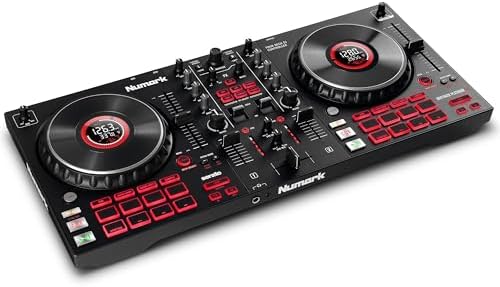
Numark Mixtrack Platinum FX DJ Controller
The most traditional layout of the four, with the deck and mixer arrangement you already recognize from club gear
The faders are the weak point on this line, and they are the part you will wear out first
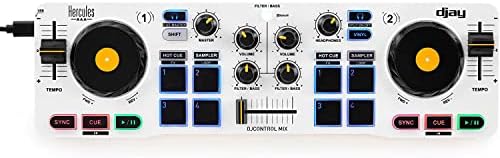
Hercules DJControl Mix, Bluetooth Wireless DJ Controller for Smartphones (iOS and Android), dJay app, 2 Decks, White
Runs from a phone over Bluetooth, so the barrier between you and a first mix is almost zero
Wireless audio puts latency into the equation, which matters the moment you beatmatch by ear
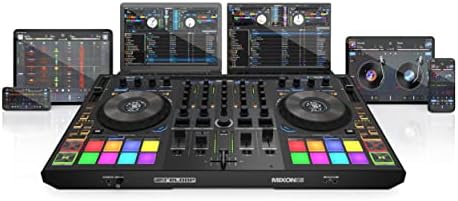
Reloop Mixon 8 Pro 4-Channel DJ Controller, Black
Four channels and a working layout aimed at people who already play out, not at people still learning
It assumes you have outgrown two channels, and it is the biggest commitment on this list
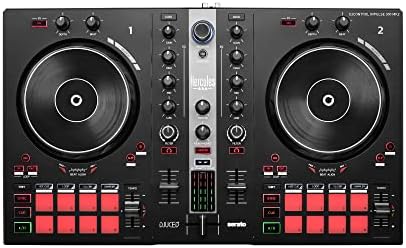
Hercules DJControl Inpulse 300 MK2-2-Deck DJ Controller Serato & DJUCED
The beat assist features teach timing instead of replacing it, which is rare at this price
Two decks and a plastic build make it a stepping stone, not a destination
Prices and availability were captured from Amazon Creators API and may change.
What I compare, and what I ignore
Four things, in this order.
First, can I play a four-hour set on it? Not a twenty-minute demo in a store. A four-hour set is where gain staging, fader feel, and layout stop being marketing copy and start being your entire evening.
Second, what do the jog wheels feel like with my eyes closed? Jog wheel feel is the soul of a controller. If the platter has no resistance and the pitch bend jumps instead of gliding, every transition feels like a mistake you are apologizing for.
Third, what software ships in the box, and does it charge you monthly for basics? The bundle is half the value of the hardware. A controller with a subscription paywall in front of basic features is a controller that keeps costing you money long after you paid for it.
Fourth, would I trust the faders at a paying gig? Faders die. The only real question is whether they die in your bedroom or in front of three hundred people at 1 a.m.
What I ignore: RGB lighting, the words "pro-grade" stamped on plastic, and spec sheets that list a frequency response for a box that only sends MIDI.
Hercules DJControl Mix: the controller that lives on your phone
The DJControl Mix is the strangest and most useful product in this group. It is a two-deck controller that connects over Bluetooth to iOS and Android and runs through the dJay app, in white, which I respect purely because it looks like nothing else on a shelf.
The point of it is not fidelity. The point is removing every excuse between you and your first mix. No laptop, no audio interface, no install marathon. You charge a phone, pair it, and you are mixing. For someone who is not yet sure whether they even like DJing, that is a genuinely lower barrier than any wired controller on this list.
The honest trade-off is wireless audio. Bluetooth adds latency, and latency stops being theoretical the moment you try to beatmatch by ear. If you plan to learn to mix properly, treat this as a starting point and move on. If you want to run a party from a phone with real faders instead of a playlist, this is a real tool, and it is the one I would hand to a friend who has never touched a controller.
It is also the only controller here that pairs with a phone as its primary setup, and that changes who it is for. A teenager with an iPhone and a Bluetooth speaker is the actual target audience, and that is a good thing for the hobby.
Hercules DJControl Inpulse 300 MK2: the one that teaches you
The Inpulse 300 MK2 ships with Serato and DJUCED, and its whole reason for existing is the teaching layer. The beat assist features do not just sync for you. They show you the timing, then step back and let you find it.
I have said for years that the Inpulse line has the best beginner features of anything in its class, because it teaches you instead of doing it for you, and that is the difference between a DJ and a person who presses sync and hopes. Watch the beat assist do its thing for a week and you start hearing where the one is without it.
Two decks is the right number. You do not need four channels to start. You need two solid channels and a brain that plans transitions, and a two-deck controller forces you to plan, because you cannot stack a third track over a bad blend and pretend it was intentional.
Where it loses is ceiling. It is a plastic two-deck controller, and there is only so far you can go with it. The day you start playing out, you will want a sturdier frame and a better crossfader. That is fine. The Inpulse is a stepping stone, and stepping stones are supposed to be temporary.
One more thing in its favor: DJUCED is included, so you get a full-featured option that does not hide the basics behind a subscription, plus Serato if you want to learn on the software you will meet in the wild.
Numark Mixtrack Platinum FX: the traditional lane
The Mixtrack Platinum FX is the most conventional controller here. Deck and mixer layout, jog wheels where your hands expect them, a design language that maps almost one to one onto what you will find in a booth.
That matters more than people admit. The industry standard is the standard for a reason, and a controller that mimics that layout means your muscle memory transfers when you finally stand behind club gear. If your plan is to eventually play out, learning on a traditional layout is not wasted time.
The catch is the Mixtrack line's weak point, which is the faders. I have said before that they feel like they are made of hope, and I stand by it. The layout is fine for a bedroom, and this is a fine first controller, but if you are the kind of person who cuts hard and often, budget for the faders being the first thing to go. Treat this as a controller you will upgrade from, not the one you keep forever.
Reloop Mixon 8 Pro: four channels for people who already gig
The Mixon 8 Pro is a four-channel controller, and that single fact puts it in a different conversation. Four channels means two decks plus room to layer, or two decks plus a microphone and a sampler, or the ability to run a whole set without reaching for a laptop trackpad in the middle of a transition.
This is not a beginner's controller. Not because beginners cannot use four channels, but because four channels solve problems you do not have yet, and the money you spend on them is money you do not spend on headphones, a stand, or a laptop that does not stutter.
Where it wins is for the DJ who already plays out and is tired of two-channel workarounds. Of the four, this is the one I would describe as a working tool rather than a learning tool, and the black finish is the least interesting thing about it. It is the pick when the question is not "can I learn on this" but "can I show up with this and not apologize."
Software is half the value
This is the part of any DJ controller comparison that gets buried under jog wheel talk.
The two Hercules units ship with DJUCED, and the Inpulse 300 MK2 also brings Serato into the room. The DJControl Mix runs through dJay on your phone. The Numark and the Reloop each bring their own bundle. Whatever you buy, the software you actually get is doing at least as much work as the hardware, and the bundle is where companies either hide real value or hide real cost.
My rule is simple. If basic features sit behind a monthly subscription, that is a subscription you pay for the entire life of the controller, and it belongs in your math before you click buy. A free tier that does everything you need for a year of bedroom practice is worth more than a spec sheet advantage you will never hear.
Jog wheels, faders, and what fails first
Three things break on a controller, roughly in this order: the crossfader, the channel faders, and the jog wheels. Everything else is usually a cable problem.
The crossfader takes the abuse because that is where scratching and cuts live. The channel faders go next, because you ride them all night long. Jog wheels tend to outlast both unless you are heavy-handed with pitch bends.
Which means the question you should ask about any controller is not "how does it feel in the store." It is "when this fader dies, can I replace it, or do I replace the whole controller." That is why I keep pushing beginners toward two-channel decks with a plan, and why I push anyone who cuts hard toward a controller whose faders can be serviced or swapped.
The jog wheel check is free, by the way. Close your eyes, put your hand on the platter, and move it a hair. If you cannot feel the resistance, you cannot make a subtle pitch bend, and subtle pitch bends are most of what mixing actually is.
Which of these four is yours
If you have never mixed and you own a phone: Hercules DJControl Mix. Lowest barrier, real results, and it does not pretend to be a club deck.
If you want to learn to mix properly and you have a laptop: Hercules DJControl Inpulse 300 MK2. Best teaching features, two decks, and a software bundle that does not nickel and dime you.
If you want a traditional layout and you are already thinking about the booth: Numark Mixtrack Platinum FX. Go in knowing the faders are the weak point.
If you already play out and you are hitting the limits of two channels: Reloop Mixon 8 Pro. Four channels, no workarounds, and a layout that assumes you know what you are doing.
Where to check each one
- Numark Mixtrack Platinum FX DJ Controller: Visit on Amazon
- Hercules DJControl Mix, Bluetooth Wireless DJ Controller for Smartphones (iOS and Android), dJay app, 2 Decks, White: Visit on Amazon
- Reloop Mixon 8 Pro 4-Channel DJ Controller, Black: Visit on Amazon
- Hercules DJControl Inpulse 300 MK2-2-Deck DJ Controller Serato & DJUCED: Visit on Amazon
Bundles and listings change, so use the links above and look for "Check current Amazon price" on each page rather than trusting anything you read from last month.
Gear does not fix bad transitions. Practice does. Buy the controller that lets you practice every night, learn your two channels properly, and upgrade when you hit a wall you can name. That is the whole secret, and no jog wheel on this list can sell it to you any faster.