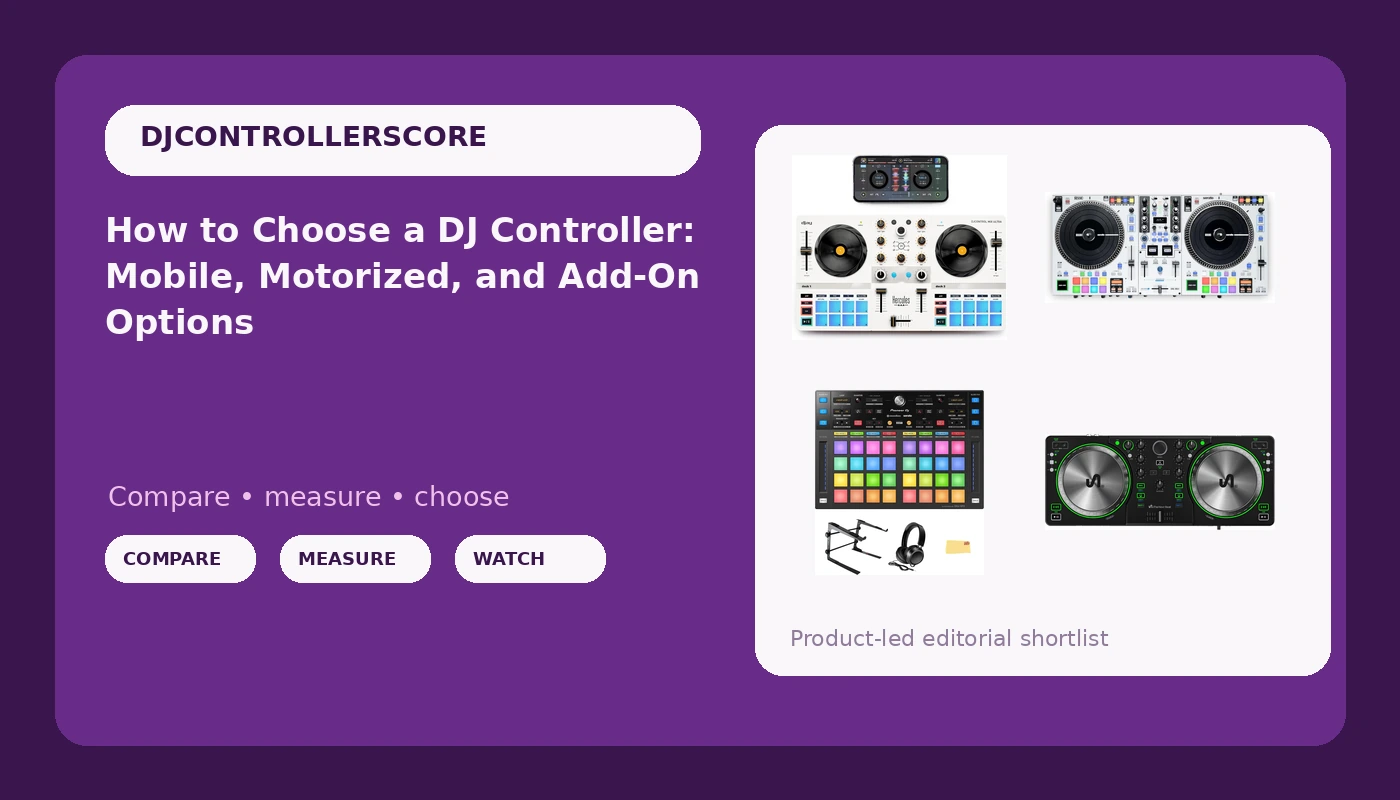
Every DJ controller question eventually collapses into the same problem: the listings look alike, the spec sheets all sound impressive, and none of them tell you whether the thing will fit the way you actually play. A useful DJ controller buying guide starts with your situation instead of a feature count. Four very different setups cover most of the ground: a mobile controller built around a phone or tablet, a portable deck aimed at people who are still learning, a motorized two-channel unit that brings vinyl-style platters into a digital library, and a pad-based add-on for players who already own the core of a rig. This article explains what each one is for, what it does not do, and which questions actually separate them.
Related: Rekordbox vs Serato: Which Software Should You Learn First →
Quick answer
Match the controller to your device and your stage, not to a feature count. If your DJ software lives on a phone or tablet and you want a small rig, the Hercules DJControl Mix Ultra is the mobile-first option here. If you are learning and want a portable deck to practice on, The Next Beat by Tiësto SX1 is designed for that. If you want moving platters and Serato DJ Pro in a two-channel layout, the RANE ONE MKII is the motorized choice. And if you already own a controller or a mixer and simply want more performance controls, the Pioneer DJ DDJ-XP2 bundle adds pads and accessories rather than replacing anything. These four are not competing for the same slot in a setup, which is why none of them is a universal answer.
4 useful options
| Model | Best fit | What stands out |
|---|---|---|
| Hercules DJControl Mix Ultra | Phone and tablet DJs who want a small rig | Mobile-first design for iOS and Android devices |
| The Next Beat by Tiësto DJ Controller, SX1 Portable Control Deck | Beginners who want a portable practice deck | Entry-level portable control deck format |
| RANE ONE MKII Motorized Serato DJ Controller | DJs who want moving platters and Serato DJ Pro | Motorized platters in a two-channel Serato layout |
| Pioneer DJ DDJ-XP2 Sub-Controller bundle | Owners adding pads to an existing rig | Sub-controller for rekordbox and Serato DJ Pro, bundled with a stand and headphones |
Mobile-first option: Hercules DJControl Mix Ultra
The trade-off here is the one people underestimate: a mobile controller is only as good as the app it talks to. You are not buying a laptop workflow with a deep plugin ecosystem. You are buying a small surface that turns a phone or tablet into something you can mix on, which is a real advantage if you want to practice on a train, at a friend's place, or in a room where setting up a laptop is more hassle than it is worth. The counterweight is that app-based DJing puts a ceiling on how much control you get over library management, effects chains, and file preparation. If your long-term plan is club work, this is a second controller, not a first one. If your plan is to play small parties, weddings, and casual sets, the mobile route removes a lot of gear from your bag.
Portable practice deck: The Next Beat by Tiësto DJ Controller, SX1 Portable Control Deck
Beginner gear gets judged unfairly. The question is never whether a starter deck is as good as a four-figure controller, because it obviously is not. The question is whether it lets you practice every night without friction, and whether it teaches you habits that transfer when you upgrade. A portable deck is good at the first part. It is small, it is meant to be picked up and used, and it lowers the activation energy that stops most beginners from practicing. The trade-off is that entry-level decks are where cheap faders and light jog wheels live, and those are exactly the parts that shape your technique. If you learn to mix on hardware that fights you, you will spend your first months compensating instead of learning transitions. Buy a starter deck with that in mind, and plan the upgrade before you need it.
Motorized platter option: RANE ONE MKII Motorized Serato DJ Controller
This is the one that changes how mixing feels, and it is also the one that costs the most. Motorized platters rotate the way turntables do, which matters if you scratch, if you came up on vinyl, or if you have never been able to trust a static jog wheel for pitch bends. It is a two-channel unit, and that is not a limitation for most DJs. Two solid channels and a brain that plans transitions will take you further than four channels you never use, and a battle-style layout keeps the controls where your hands already want to go. The honest caveats: it is heavy, it assumes Serato DJ Pro is your software of choice, and it is a serious commitment for a hobbyist. If you are still deciding between ecosystems, settle that question first, because switching later is expensive.
Add-on control option: Pioneer DJ DDJ-XP2 Sub-Controller for Rekordbox & Serato DJ Pro Bundle
Read the description carefully, because this is the product people buy by mistake. It is an add-on. There are no jog wheels and no mixer section, so it does not replace a controller, it extends one. What it does is give you a large bank of performance controls for hot cues, pad effects, sampler triggers, and the kind of finger drumming that a two-channel controller's eight pads cannot cover. That makes it a genuinely good second purchase for someone who already has a working rig and keeps running into the same wall: not enough buttons under their hands. The bundled laptop stand and headphones also matter more than they sound, because those are two items nearly every new DJ ends up buying separately. Just do not buy this as your first piece of gear.
Prices and availability may change. Product images, names, and retailer links are matched to verified listings. No current price, rating, stock status, or measured result is stated here without current evidence.
What the software bundle actually decides
Hardware gets the attention, but the software determines whether you enjoy the controller six months in. The three ecosystems you will run into are rekordbox, Serato DJ Pro, and the mobile app world that controllers like the Hercules Mix Ultra are built around. They behave differently in ways that matter more than pad counts.
Rekordbox is the Pioneer route, and its library and export workflow is why so many club DJs organize their music there. Serato DJ Pro is the long-standing battle and scratch standard, and the RANE ONE MKII is built around it. Mobile apps are the newest of the three and the least standardized, which cuts both ways: setup is faster and more casual, but your library, your cue points, and your file prep may not transfer cleanly to a laptop setup later.
Two practical checks before you buy anything. First, confirm what software tier the hardware actually unlocks. Some controllers include a full license, others unlock a limited mode, and some rely on a subscription for the features you assumed were included. Second, decide whether you are willing to pay a recurring cost at all. A subscription for basic functionality is one of the fastest ways to sour a setup you otherwise like, and it is worth knowing that before the hardware arrives rather than after.
Platters, faders, and the parts you can feel with your eyes closed
Specs describe a controller. Feel is what you live with. The jog wheel is the clearest example: a platter with no resistance makes every pitch bend feel like a guess, and no amount of feature depth fixes that. The same goes for faders, which are the parts most likely to wear out first. A crossfader that feels fine in a shop can develop a ragged edge after a year of aggressive cuts, and the only way to judge it is by how it responds under your hand, not by what the marketing copy says.
Motorized platters sidestep part of this problem because the mechanism is doing the work, but they add weight and cost. Static jog wheels are lighter and cheaper, and good ones feel precise enough for clean transitions. The middle ground is where most people land.
Here is a decision order that keeps you from buying the wrong thing:
- Decide which device the controller has to work with: phone, tablet, or laptop.
- Decide whether you need moving platters or whether static jog wheels are enough.
- Check what software tier the hardware unlocks and whether any feature requires a subscription.
- Count the channels you will genuinely use, then ignore the rest.
- Budget for the accessories you will need on day one, including a stand, headphones, cables, and a case.
Practical guidance before you buy
- Buy for the room you actually play in, not the room you hope to play in next year.
- Treat a starter deck as a practice tool with a known shelf life, and plan the upgrade path early.
- Read the bundle contents line by line, because sub-controllers and accessories get mixed into listings that look like complete setups.
- Confirm software compatibility before purchase, especially if your library is already organized in another ecosystem.
- Assume any fader will eventually need attention, and factor in whether replacement parts and service are realistic for your budget.
Which option should you choose?
Choose the Hercules DJControl Mix Ultra when your DJ software lives on a phone or tablet and you want a rig that fits in a bag. Choose The Next Beat by Tiesto DJ Controller, SX1 Portable Control Deck when you are starting out and want a portable deck you can practice on nightly. Choose the RANE ONE MKII Motorized Serato DJ Controller when you want motorized platters, a two-channel battle layout, and Serato DJ Pro at the center of your setup. Choose the Pioneer DJ DDJ-XP2 Sub-Controller for Rekordbox & Serato DJ Pro Bundle when you already own a controller or mixer and want more pads plus a few accessories you would otherwise buy separately.
Two limits apply to everything above. Listings change: bundles get repackaged, software tiers get revised, and the current product page is the only reliable check. And none of these descriptions are measurements. No durability claim, no test result, and no long-set performance claim is being made here, because none of that has been verified. Use the specs and bundle contents as a starting point for your own research.
The bottom line
The mistake most buyers make is shopping for a controller instead of shopping for a setup. A mobile controller, a portable practice deck, a motorized two-channel unit, and a pad-based sub-controller are four different answers to four different questions, and buying the wrong one usually means paying twice. Decide what device you are playing from, decide whether you need moving platters, confirm what the software actually unlocks, and then buy the piece that completes your rig instead of the piece with the longest feature list. If you already own the core of a setup, the Pioneer DJ DDJ-XP2 bundle extends it. If you are starting from nothing on a phone, the Hercules DJControl Mix Ultra is the low-friction entry. If you want the feel of vinyl with a digital library, the RANE ONE MKII is the serious commitment, and The Next Beat by Tiësto SX1 sits in between as a portable place to learn.