Related: How to Set Up Your First DJ Controller Without Losing an Evening
The best DJ controllers for beginners are not the ones with the longest spec sheet. They are the ones you can plug in on a Tuesday night, practice transitions on for two hours, and still trust on a Saturday. I have been a club DJ for eight years and a wedding DJ for five, and I have watched more people quit this hobby over gear feel than over bad taste in music. Nobody walks away because their library is thin. They walk away because the jog wheel felt like a toy steering wheel and every mix felt like a mistake they made personally.
Here is how gear reveals itself. In the first hour of a set, you are not thinking about the controller at all. You are reading the room, watching the floor fill or not fill, deciding whether the next track is the one that turns the night. If the gear is wrong, that is the hour where it tells you: a jog wheel with no resistance, a crossfader that already feels loose, a channel fader that jumps instead of gliding. Everything below is about surviving that hour, not about winning an argument on a forum.
This guide runs a ladder. A two-channel unit for your first year, a budget option that will not embarrass you at a house party, a controller built for streamers and content creators, and one wildcard for people who want something that does not feel like everything else on the shelf. No spec-sheet worship, and no "pro-grade" stickers on plastic.
Software bundles matter more than hardware specs, and I will keep saying it until it stops being true. A controller is only as good as what it ships with, because the software is where you actually learn to mix. If the bundle hides basic features behind a monthly subscription, that is a tax on a hobby you are still deciding whether you love. Check the software story before you check the channel count.
Best for Beginners: AlphaTheta DDJ-FLX2 Compact 2-Channel
This is the one I tell people to buy first. It is compact, it is two channels, it runs over USB-C, and Smart Fader quietly covers for you when your transition is not where it should be. You do not need four channels to start. You need two solid channels and a brain that plans transitions, and this controller is built around exactly that idea.
Close your eyes and touch the jog wheel. That is the review. On the cheap stuff, your hand knows within ten seconds that the platter has no weight and no resistance, and your pitch bends turn into a series of small humiliations. This one is small, so the platters are small, which means you learn light hands early. That is a feature. People who learn on oversized platters and heavy hands spend their first year fighting their own wrists.
The compact body is the real argument. A controller that lives on your desk gets used. A four-channel unit that stays in a bag because it does not fit next to your monitor gets used twice a month, and twice a month does not build muscle memory. The controller you practice on every night is the controller that makes you good. Everything else is furniture.
The honest caveats: small pitch faders, fewer controls, and you will outgrow it if you decide you want to juggle four decks. But the AlphaTheta name sits in the same family as the gear you will find in most booths, and gear from that lineage tends to resell easily when you upgrade. Buying into a standard is not selling out. It is skipping a step.
Best Budget Pick: Numark Mixtrack Platinum FX
The Mixtrack line is fine for bedroom DJs. I have said that for years and I stand by it. It is also the line where the faders feel like they are made of hope, and I stand by that too. If your budget is the deciding factor and you want a controller with a full layout and an effects section in the name, this is a reasonable place to land. Just go in knowing what you bought.
Here is the test that matters, and it is not a fun one. Faders die. The only question is whether they die at a gig or after 500 hours in the studio. A budget crossfader that feels acceptable in week one can feel vague by month six if you are a cutter. If you are a slow-blend DJ who mostly works channel faders, you will get years out of it. If your style is aggressive cuts, you are the person who wears it out, and you should plan for that instead of being surprised by it.
The layout is honest, and the Platinum FX name is not decoration. It gives you the controls you want at this level without pretending to be a club mixer. What it will not give you is the tactile confidence of a heavier unit. The jog wheels are functional rather than satisfying, and functional is fine until the night you have to pitch bend under pressure in front of people.
Buy it as a first controller, a second controller for the guest room, or a backup that lives in the car. Do not buy it as the last controller you will ever own. And when you upgrade, keep it. A backup controller has saved more weddings than any piece of gear I own.
Best for Live Streaming: Roland DJ-707M
Roland gear is weird and wonderful, and this one is aimed squarely at the people who talk between songs. If your sets involve a microphone, a stream, a second room, or an audience that is not standing in front of you, this is the controller on this list built for that job. That is the whole pitch, and it is a good one, because most controllers treat a microphone as an afterthought and most streaming setups treat audio routing as a problem to solve later.
I have done enough weddings to know that the gear which fails is rarely the gear that mixes. It is the gear that has to handle a toast, an announcement, a walk-in playlist, and a room that needs music while you eat dinner. Routing is the unglamorous half of this job, and a controller designed for content creators understands that the audio path is the product.
Feel-wise, this is a bigger, more deliberate instrument than the compact units above. The jog wheels reward a confident hand, and the layout gives you room to work instead of making you fold your fingers into a corner. It is not the cheapest way to learn to beatmatch, and it is not supposed to be.
The caveat is straightforward: if you only ever mix two tracks for yourself, you are paying for routing you will not use. Buy this when the microphone matters. Buy this when the stream matters. Otherwise, put the money into practice time and a smaller controller.
The Wildcard: Hercules DJ Control T10
Hercules has spent years building beginner tools that actually teach instead of doing the work for you, and that philosophy is what makes this one worth a look. A beat assist that shows you what you did wrong is worth more than a button that hides the mistake. If the T10 follows that tradition, it belongs on a shortlist for anyone who wants to learn the craft rather than perform it.
This is the wildcard because it does not sit on the standard path. The standard path has a community around it, a resale market, and a booth full of familiar layouts. Deviating from that path costs you something, and you should know the price before you pay it. What you get in return is a different take on the same job, and sometimes a different take is exactly what keeps you practicing.
Treat it as the second controller, the one you buy when you already understand gain staging and you want a different feel under your hands. Or treat it as the first one if you are the kind of person who reads manuals for fun and does not care what the booth at the club has in it.
What I would not do is buy it expecting it to behave like everything else. Different gear asks different questions, and the answer to those questions is practice.
How I tested
Every controller that gets a recommendation from me goes through the same three-part test. No 30-minute impressions, no unboxing videos.
First, a full-length set. Four hours, real transitions, real track selection, no do-overs. If I cannot play a marathon on it without my hands getting tired or my ears getting annoyed, it does not get a recommendation.
Second, a fader smash session. Aggressive cuts, fast crossfader work, the kind of handling that would void any warranty. This is where cheap faders announce themselves.
Third, the jog wheel feel check with eyes closed. Feel beats specs. If I cannot find the platter without looking, the layout is wrong.
Then I live with it. Practice nights, a house party, a stream, whatever the unit is built for. Gear is not the bottleneck, practice is, so the question is always whether this thing makes practice easier or harder.
Analysis and test results
The pattern across all four is simple: the software bundle and the jog wheels decide everything, and the spec sheet decides almost nothing.
Jog wheel feel is the soul of a controller. A platter with no resistance makes every pitch bend feel like a guess, and you can hear it in a mix even when the beatmatching is technically correct. The compact units here ask you to develop light hands, which is a good habit. The larger units reward a confident hand, which is a different good habit. Neither is wrong. What is wrong is a wheel that gives you nothing back.
Faders are the part that dies. Budget crossfaders go vague with aggressive cutting, and no amount of careful gain staging saves a fader that has stopped returning to zero. If you cut hard, budget for replacement or buy the unit that feels heavier from day one.
Gain staging is the skill nobody buys gear for. No controller on this list will stop you from clipping a channel, and none of them will fix a transition that was planned badly. The gear sets a ceiling on feel. It does not set a ceiling on taste.
And the resale question is real. Buying into the standard layout means your upgrade path is easy and your old unit sells quickly. Buying the wildcard means you keep it, which is fine if you love it and less fine if you do not.
None of these are what I would call club standard, and I am not going to pretend otherwise. The DJ-707M is the one here built for the kind of job where a microphone matters, and that is as far as I will take the claim.
The DJ controller reference table
This is the table I keep for friends who text me at midnight asking what to buy. Role first, feel second, software third. The price column is where you check, because prices move and I do not quote numbers that will be wrong by the time you read this.
| Controller | Who it is for | Jog wheels and faders | Check this first | Price |
|---|---|---|---|---|
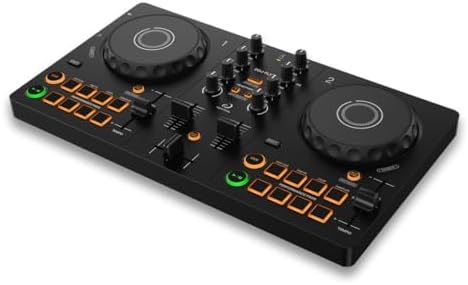 Visit on Amazon → Visit on Amazon →AlphaTheta DDJ-FLX2 |
First controller, desk practice, house parties | Small platters that teach light hands; Smart Fader covers early mistakes | Whether the bundled software does what you need without a subscription | Check current Amazon price |
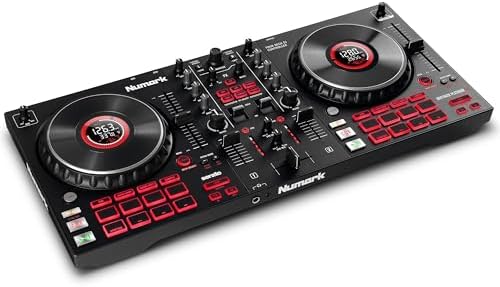 Visit on Amazon → Visit on Amazon →Numark Mixtrack Platinum FX |
Budget first controller, backup unit, second setup | Functional rather than satisfying; faders are the wear item | How hard you cut, because that is what kills budget faders | Check current Amazon price |
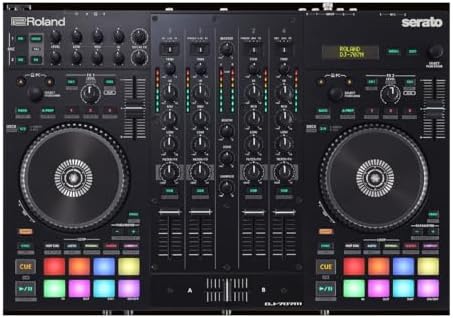 Visit on Amazon → Visit on Amazon →Roland DJ-707M |
Streamers, wedding and mobile DJs, anyone with a microphone | Heavier, deliberate feel that rewards a confident hand | Whether you actually need the routing and mic workflow | $1,139.99 |
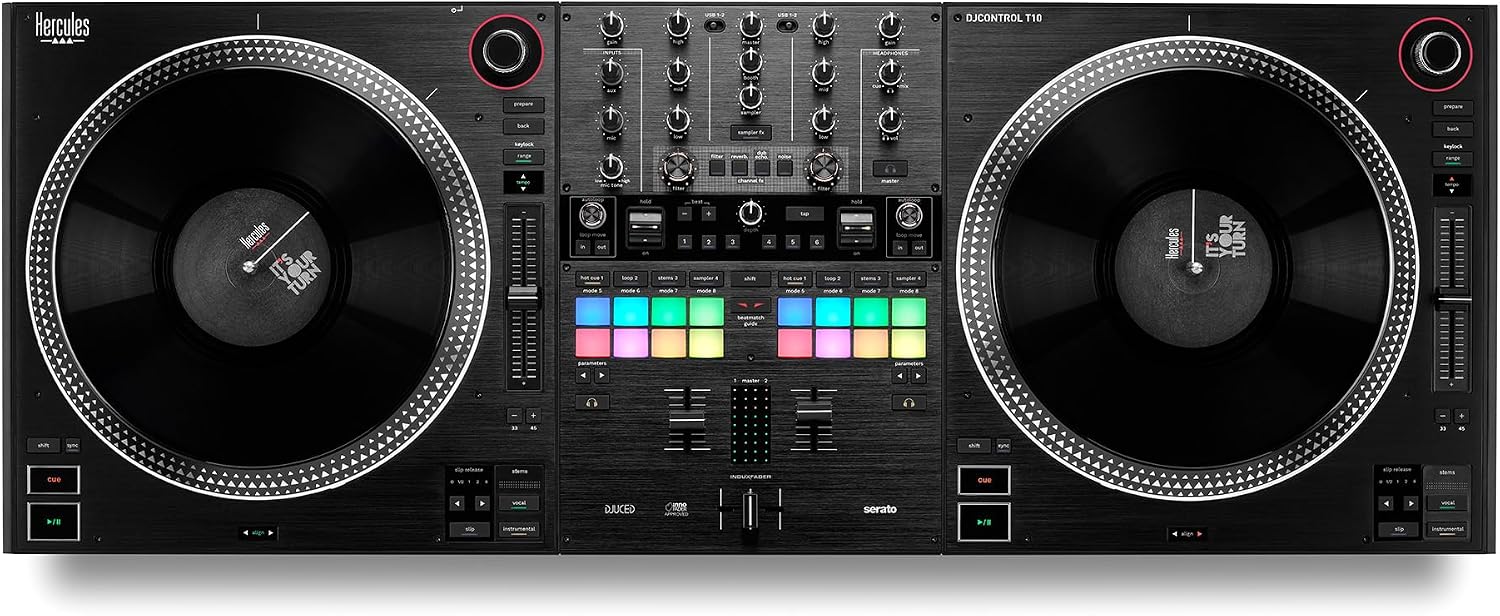 Visit on Amazon → Visit on Amazon →Hercules DJ Control T10 |
Learners who want teaching tools, tinkerers, second controller | A different take on the same job; judge it with your eyes closed | Whether you are comfortable off the standard path | $1,399.99 |
Should you buy the AlphaTheta DDJ-FLX2?
Yes, if you are starting out and you want two channels that behave. It is compact, it runs over USB-C, and Smart Fader takes the edge off your first bad transitions while you learn to hear what a good one sounds like. It is the controller I hand to friends who ask what to buy first, and it is the one that will not end up in a closet.
Should you buy the Numark Mixtrack Platinum FX?
Yes, if the budget decides and you are a slow-blend DJ. No, if you are a cutter, because you will be the person who wears out the fader, and you should buy the heavier-feeling unit instead. It is a good first controller and an excellent backup.
Should you buy the Roland DJ-707M?
Yes, if your sets involve a microphone, a stream, or a room full of people who are not standing in front of you. It is built for the job where routing matters as much as mixing. If you only mix for yourself, put the money into practice time and a smaller controller.
Should you buy the Hercules DJ Control T10?
Yes, if you want a controller that teaches instead of one that performs for you, and you do not care about matching the booth at the club. It is the wildcard on this list, and wildcards reward the people who read the manual.