Related: Best Beginner DJ Controller: FLX2 vs FLX4
I've been testing DJ controllers for years, and my method hasn't changed: a four-hour set with real transitions, a fader smash session, and a jog wheel feel check with my eyes closed. If a controller can't survive that, it doesn't get my recommendation. This guide covers the DJ controller bundles I'd actually spend my own money on in 2026, from the AlphaTheta DDJ-GRV6 down to the compact FLX2.
The first controller I ever bought was a cheap plastic thing with jog wheels that felt like a toy steering wheel. I replaced it within six months. That's the lesson I try to pass on to every beginner who asks me what to buy: gear is not the bottleneck, practice is, but bad gear makes practice miserable. Buy something that feels good in your hands and you'll practice every night. Buy something that feels cheap and you'll quit by March.
I've played everything from 200-capacity basements to a 4,000-person warehouse, and I've learned that the gear disappears when it's right. You stop thinking about the controller and start thinking about the music. That's the goal. Everything in this guide passed the test where the gear disappears.
Best Overall: AlphaTheta DDJ-GRV6
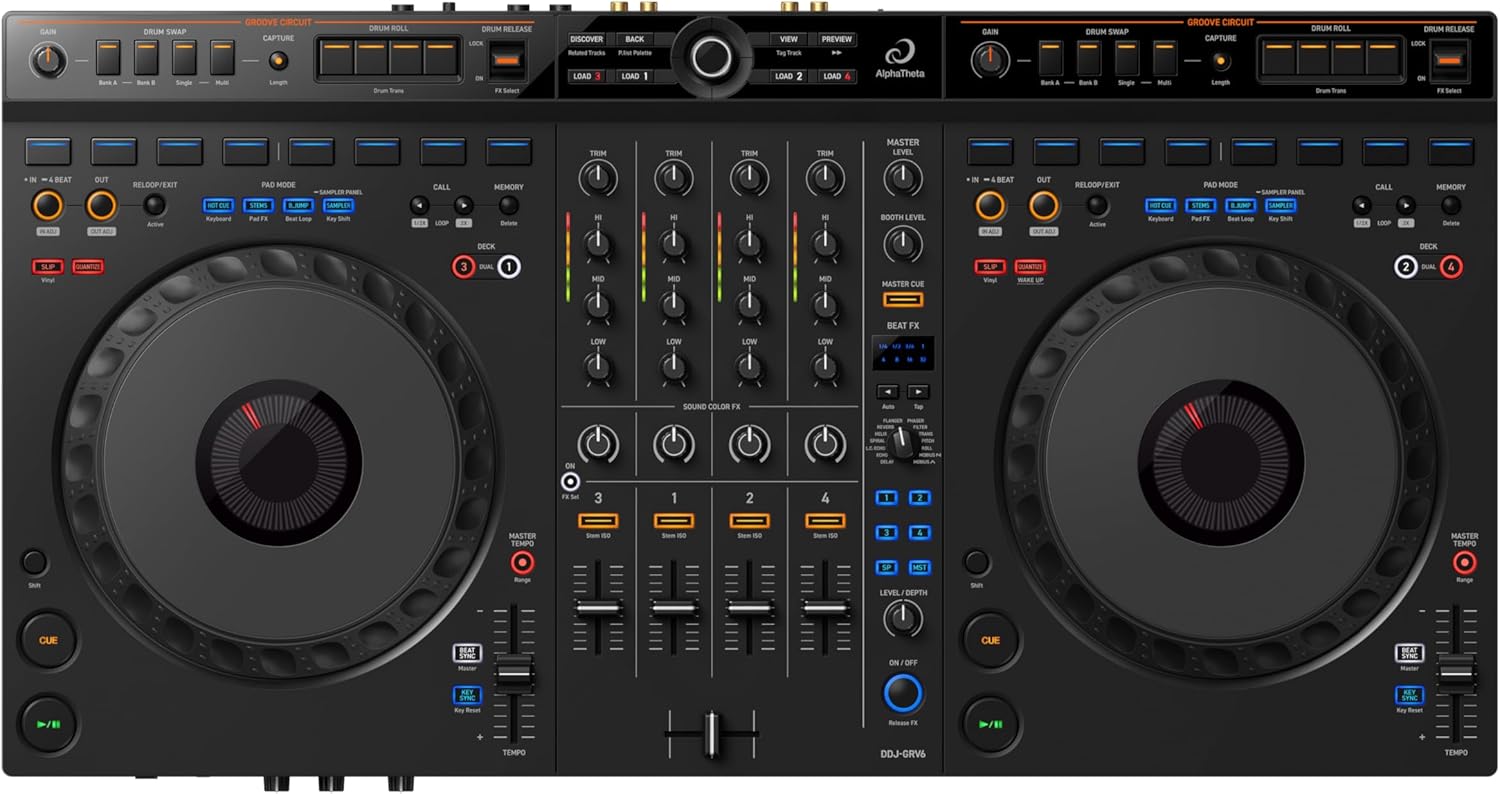
This is the controller I reach for when I have a paying gig and I need the gear to disappear so I can do my job. The DDJ-GRV6 is a 4-channel controller with the Groove Circuit, and it's the closest thing to a club rig in a portable package that I've tested.
The jog wheels are the first thing I check. I close my eyes and touch the platter. Cheap wheels feel like a toy steering wheel, all plastic and no resistance. The GRV6's wheels have weight behind them. They respond to light touches and they don't bounce back like a rubber band. After a four-hour set, my hands still feel like they're in control.
The faders matter just as much. I've killed crossfaders in a year of aggressive cuts on cheaper controllers. The GRV6's faders have held up through my fader smash test, which is exactly what it sounds like: I cut, I smash, I abuse the crossfader until something breaks. Nothing broke. That's the test.
The Groove Circuit is the feature that sets this apart. It's not a gimmick. It gives you a creative edge that cheaper controllers just don't have, and it's the reason I keep reaching for this one over my older gear. When I'm playing a wedding and need to transition from a slow song into something the dance floor actually wants, the Groove Circuit gives me options I didn't have on my old setup.
The layout is also worth mentioning. The channel strips are spaced the way they are on club gear, which means when I step behind a real mixer at a venue, my muscle memory carries over. That's something beginners don't think about, but it matters the moment you play your first gig on house gear.
The Full Rig: DDJ-GRV6 Bundle
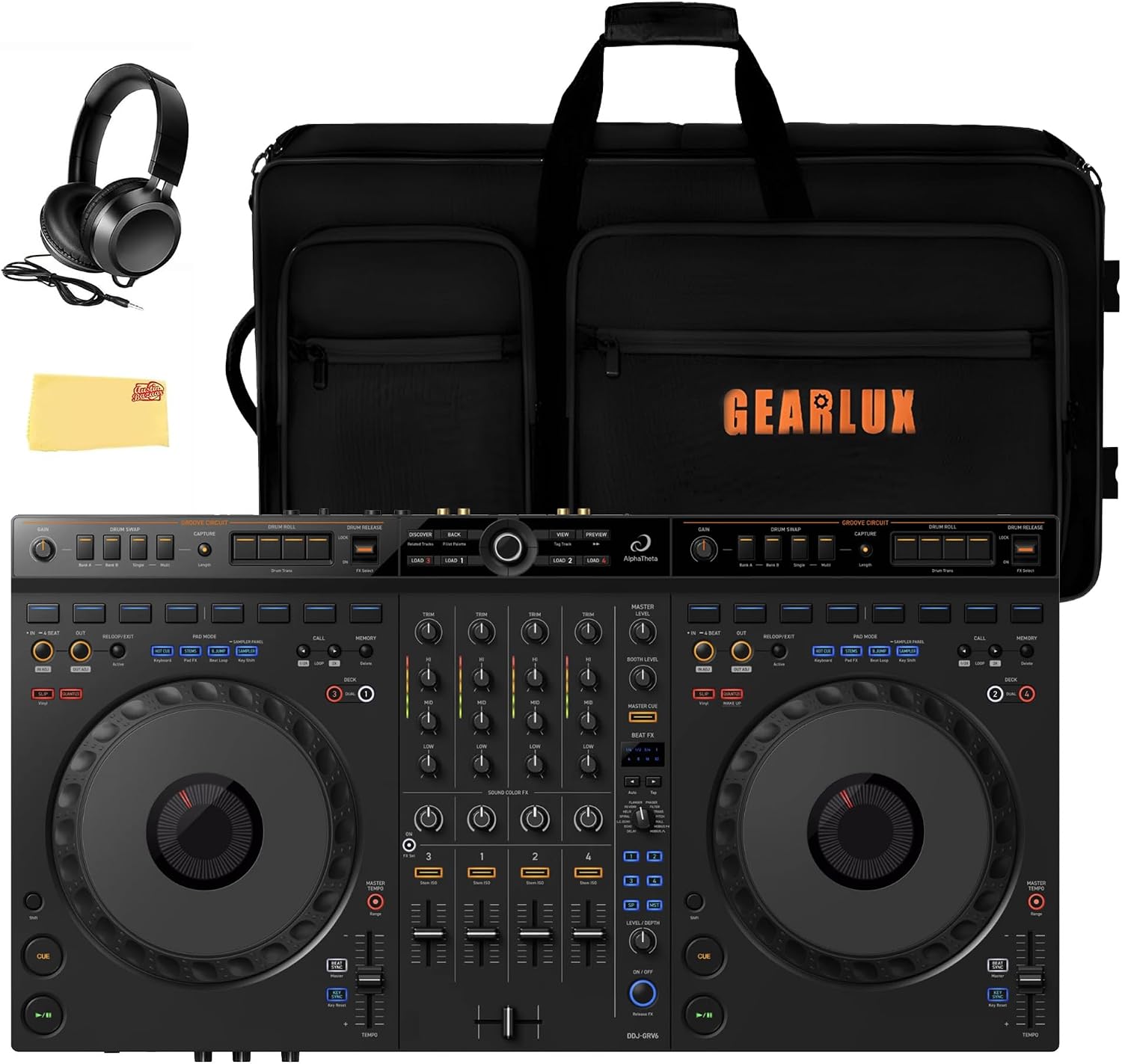
If you're buying your first serious 4-channel rig, the bundle is the move. It takes the same GRV6 controller and adds a carrying case, a pair of headphones, and a polishing cloth. That's the difference between buying a controller and building a setup.
The case is the part I care about most. I've seen too many controllers die in backpacks, jog wheels knocked out of alignment, faders snapped by a careless zipper. A hard case protects your investment, and this bundle includes one that fits the GRV6 properly. No jiggling, no rattling, no surprises when you open it at the gig.
The headphones are a bonus. They're not the last pair you'll ever buy, but they're good enough to mix with on day one, and they'll hold you over until you decide whether you prefer closed-back or open-back for your own monitoring style. I've played entire sets on headphones half this good, and I've seen headliners do the same.
The polishing cloth is the kind of thing you think you don't need until you've wiped down a controller after a sweaty basement set. Keep it in the case. You'll thank me. I keep one in every case I own, and it's the first thing I grab when I'm packing up after a gig.
Best for Beginners: Pioneer DJ FLX2 Bundle
The FLX2 is the controller I recommend to every beginner who asks me where to start. It's a compact 2-channel controller that teaches you the fundamentals without drowning you in features you don't need yet. You don't need 4 channels to start. You need 2 solid channels and a brain that plans transitions.
The bundle adds a carrying case, a TRS cable, and a polishing cloth. That's everything you need on day one. No trips to the music store, no realizing you forgot the cable that connects your controller to your speakers, no digging through drawers for a cloth to wipe down your gear. I can't tell you how many beginners I've seen buy a controller and then realize they don't have the cable to plug it into anything.
The jog wheels on the FLX2 are honest. They're not the full-size platters you'll find on a club rig, but they have enough resistance that you can learn proper technique instead of developing bad habits on wheels that feel like nothing. That matters more than you think. Bad habits from cheap gear follow you into your first club gig.
The software bundle is half the value. The FLX2 works with the same software ecosystem that the big controllers use, which means when you upgrade, your library and your muscle memory come with you. That's the smart way to start. I've seen too many beginners buy a controller that works with a dead-end app and then have to start from scratch when they upgrade.
The Case for Your FLX4
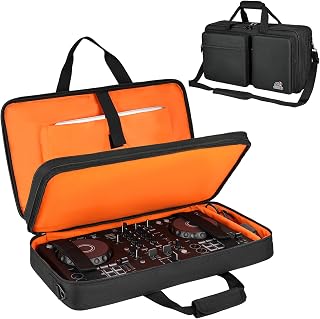
If you already own a Pioneer DDJ-FLX4 or a Numark Mixtrack Platinum FX, this case is the accessory that keeps your controller alive. I've said it before and I'll say it again: controllers die in transit, not in the mix. A case that fits your controller properly is the cheapest insurance you can buy.
The FLX4 is the best gateway drug in DJing. It's the controller I recommend to friends who want to learn, because it includes Rekordbox and it resells easily when they upgrade. But it deserves a case. This one is made for it, and it fits the Mixtrack Platinum FX too, which makes it a solid choice if you're in the Numark camp.
I've carried controllers through Brooklyn streets in the rain, packed them into trunks for wedding gigs, and thrown them into the back of a van for warehouse parties. The ones that survived all had cases. The ones that didn't are in a drawer somewhere, waiting for a repair that's not worth the cost.
How I tested
Every controller in this guide went through the same testing protocol. The marathon test: a four-hour set with real transitions, not a 30-minute bedroom session. The fader smash test: aggressive cuts until something breaks or I run out of patience. The jog wheel feel check: eyes closed, hands on the platter, no looking at the brand.
I also lived with each controller for a month. I took them to gigs, I practiced at home, I packed them into cases and carried them through the city. A controller that only works in your bedroom isn't ready for the real world. I test the way I play, and I play the way I test.
Gain staging is part of the test too. Setting levels so your mix doesn't clip is the skill nobody buys gear for, but a good controller makes it easy and a bad one makes it a fight. I checked every input, every channel strip, every time I had to reach for the trim knob to keep the red lights off.
Analysis and test results
Jog wheel feel is the soul of a controller. Cheap plastic wheels make every mix feel like a mistake. The GRV6's wheels have real weight and resistance, and they held up through the full test. The FLX2's wheels are honest for the price point, with enough resistance to teach proper technique.
Faders die. The question is whether they die at a gig or after 500 hours in the studio. The GRV6's faders survived my smash test. That's the standard I hold every controller to, because I've had faders die at weddings and it's not a memory I want to repeat. The FLX2's faders are fine for the price, but if you're planning to cut aggressively for years, budget for an upgrade eventually.
Software bundles matter more than hardware specs. A controller is only as good as the software it ships with. The FLX2 and GRV6 both work with the industry standard ecosystem, which means your library and your skills transfer when you upgrade. That's the hidden value of these bundles. I've seen too many controllers gather dust because the software was a dead end.
The bundles themselves are where the real value lives. A controller plus a case plus the cables plus the cloth adds up to more than the sum of its parts. You're paying for the convenience of having everything on day one, and for a beginner, that convenience is worth every dollar.
The comparison table
This is the table I keep in my studio, and it's the same one I use for every controller I test. These are starting points, not gospel.
| Controller | Channels | Best For | Notes |
|---|---|---|---|
 Visit on Amazon → Visit on Amazon →AlphaTheta DDJ-GRV6 |
4 | Club-ready performance | Groove Circuit, solid faders, weighty jog wheels |
 Visit on Amazon → Visit on Amazon →DDJ-GRV6 Bundle |
4 | Full setup | Adds case, headphones, and polishing cloth |
 Visit on Amazon → Visit on Amazon →DDJ-FLX2 Bundle |
2 | Beginners | Compact, case and TRS cable included |
 Visit on Amazon → Visit on Amazon →Controller Case |
N/A | FLX4 and Mixtrack owners | Protects your gear in transit |
The key is the jog wheel. Almost everything you do as a DJ flows through the platter, and a wheel that feels cheap will make every mix feel like a mistake. Test it with your eyes closed. That's the review.
Should you buy the AlphaTheta DDJ-GRV6?
Yes, if you want a 4-channel controller that feels like a club rig. The jog wheels hold up through a full set, the faders survive aggressive cuts, and the Groove Circuit gives you a creative edge that cheaper controllers just don't have. I've used it at paying gigs and it never let me down.
If you're on a budget, the standalone unit is the way to go. If you need a case and headphones anyway, the bundle is the better value. Either way, you're getting the same controller, and it's the one I'd buy with my own money.
Should you buy the Pioneer DJ FLX2 bundle?
If you're starting out, yes. The FLX2 is a compact 2-channel controller that teaches you the fundamentals without drowning you in features. The bundle adds a carrying case, a TRS cable, and a polishing cloth, which means you have everything you need on day one.
Start with this, learn your transitions, and upgrade when the gear becomes the bottleneck. That's how every working DJ I know started. Gear is not the bottleneck, practice is, and the FLX2 bundle gives you everything you need to practice every night.