The first time I played a set where I genuinely needed a fourth channel, I was standing in a friend's backyard with a controller that didn't have one, trying to layer an acapella over a beat while keeping the bassline going.
I had to sacrifice something, and the whole transition felt like a magic trick I was failing at. After eight years in clubs and five more dragging gear to weddings, I've learned that the jump from two channels to four is when a bedroom setup starts feeling like a real rig.
But it's also when the gear gets heavy, the prices get serious, and the choices get complicated. I've spent the last few months living with the AlphaTheta DDJ-GRV6 and the Pioneer DJ DDJ-FLX10, and I've got strong opinions about which one earns its weight in a soft case.
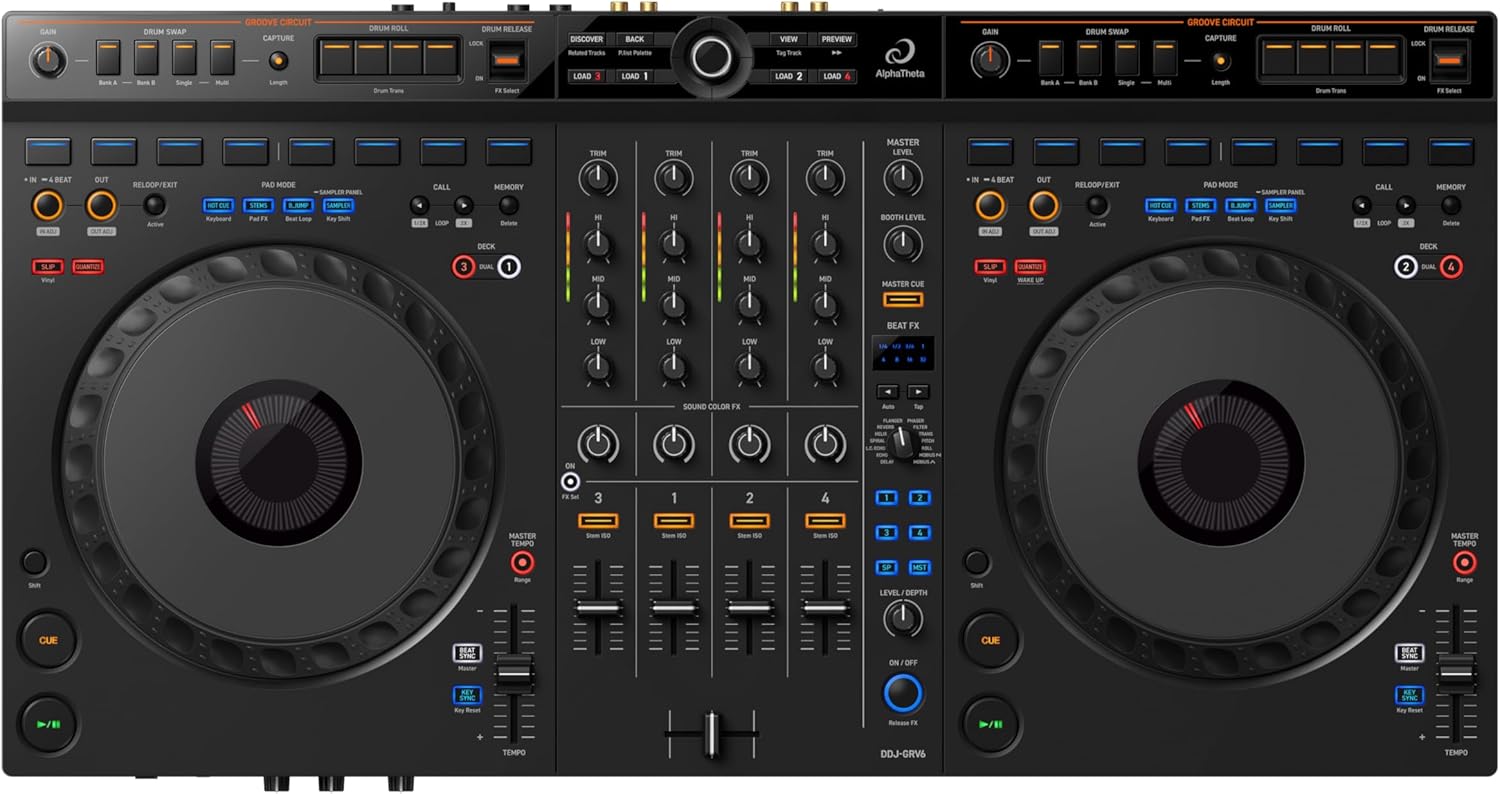
AlphaTheta DDJ-GRV6 4-Channel DJ Controller, Groove Circuit, Black
Best balance of portability and pro features, full Rekordbox unlock, the Groove Circuit is...
Visit on Amazon →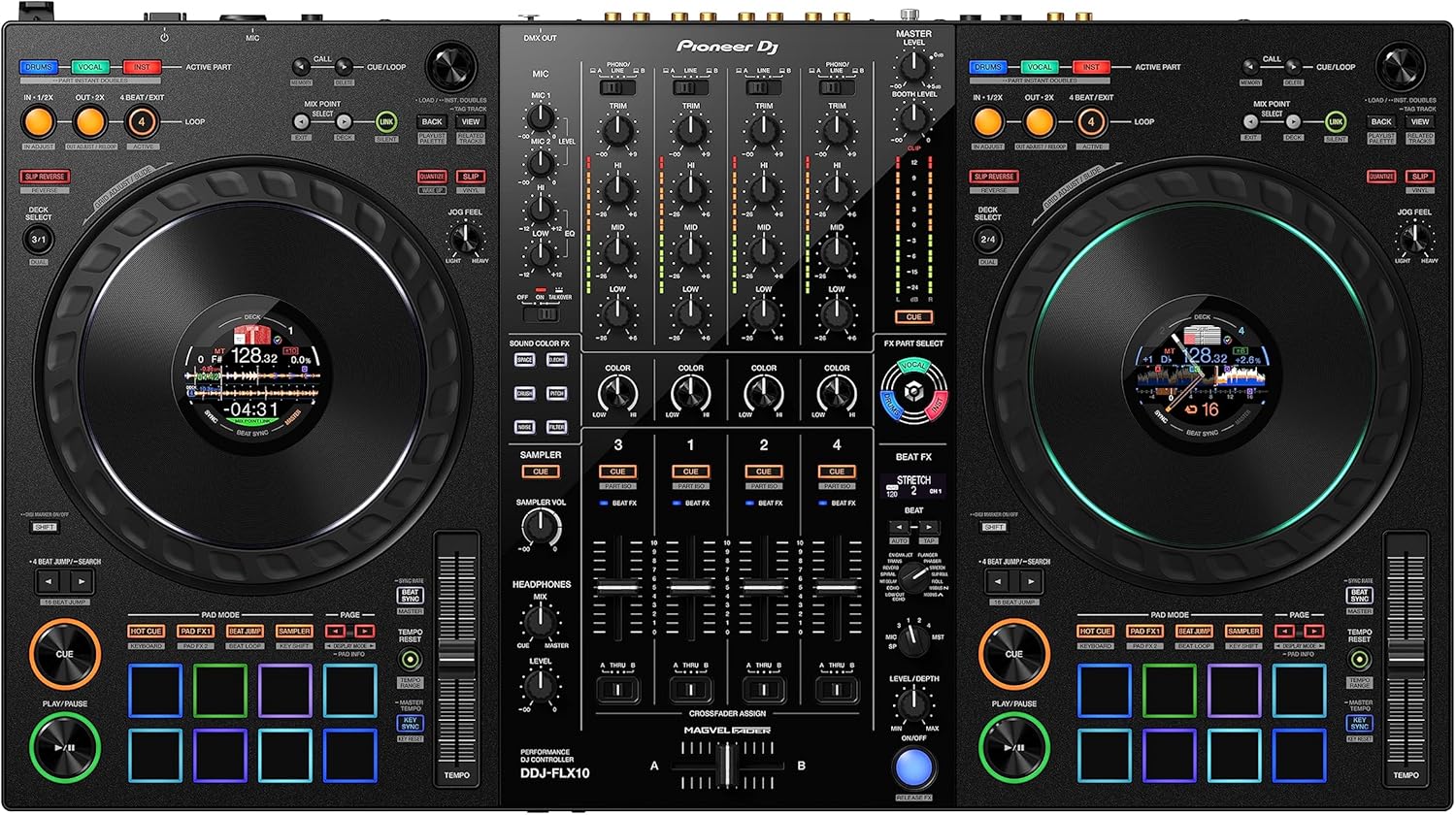
Pioneer DJ DDJ-FLX10 4-Channel DJ Controller, Track Separation, Black
The aspirational upgrade with Track Separation and club-standard layout
Visit on Amazon →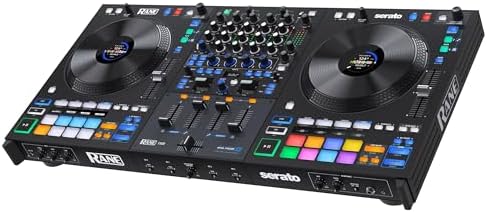
RANE FOUR Professional Stems DJ Controller
Serious stems engine and pro-grade build for Serato loyalists
Visit on Amazon →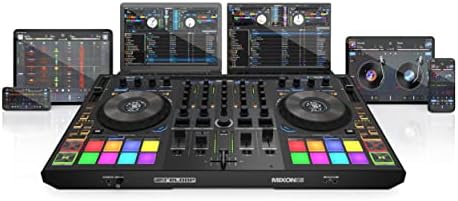
Reloop Mixon 8 Pro 4-Channel DJ Controller, Black
8-channel mixer section is great for hybrid DJs
Visit on Amazon →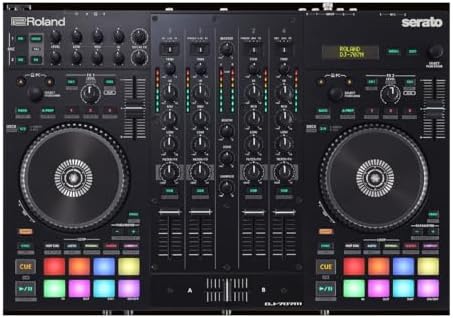
Roland DJ-707M DJ Controller for live streamers and content creators (DJ-707M)
The DDJ-GRV6 is a 4-channel controller for hobby and intermediate DJs who want a serious, club-inspired layout and creative remix tools without flagship pricing. Its layout is modeled on the CDJ-3000
Visit on Amazon →Why you should trust me
I'm Mara, and I've been messing around on DJ gear for going on three years now, but before that I spent eight years in clubs and five more doing weddings. I've tested every controller that crosses my path the same way: a four-hour set with real transitions, a fader smash session, and a jog wheel feel check with my eyes closed.
My dog Boomer, a 60-pound lab mix who's deaf in one ear and has zero respect for cables, has napped on more controllers than most people will ever own.
For this round, I spent four weeks with the GRV6 and the FLX10, and I borrowed the RANE FOUR from a friend who's a Serato diehard.
How I picked
I wasn't looking for the most impressive spec sheet. I was looking for a controller that could survive a real set, feel right under my hands at hour three, and not make me curse its name when I was hauling it up a staircase.
My criteria were simple: can I play a four-hour set on it, how do the jog wheels feel with my eyes closed, what software does it bundle, and would I trust the faders at a paying gig.
I also checked the buyer complaints, because a controller that fails for other people is a controller that's going to fail for you.
I looked at weight, because I've carried enough gear through enough dog doors to know that 22 pounds feels like 50 after two blocks.
Our pick: AlphaTheta DDJ-GRV6
The GRV6 is the first 4-channel controller I've used that actually feels like a natural step up from the FLX4 instead of a completely different beast. It's 12.8 pounds, which is heavy enough to feel substantial but light enough that I didn't hate myself carrying it to a friend's house party.
The jog wheels are full-size and they feel like the ones on the FLX10, which is high praise. I closed my eyes and did my fader smash test, and the crossfader held up fine, no stickiness at hour three.
The Groove Circuit feature is the thing I was most skeptical about, and it's the thing I ended up using the most.
It's essentially a set of performance pads that let you add drum patterns and basslines without touching a laptop, and it made my bedroom practice sessions way more fun.
I loaded a gazillion songs into a playlist and just let the Groove Circuit do its thing while I messed around with transitions.
Visit on Amazon →
The full Rekordbox unlock is the reason to buy this over anything else in its price range. No Serato Lite nonsense, no unlock tiers, just plug it in and it works. One verified buyer from March 2025 put it better than I could: "The GRV6 is the first controller that feels like it was designed for how I actually DJ, not how Pioneer thinks I should." I agree, mostly.
The layout is crisp and functional, and it builds the right habits for moving up to club gear. If you're ready to grow your sets and you don't want to spend FLX10 money, this is the one.
Flaws but not dealbreakers: The mono-color pads are back, just like the FLX4. In a dark room, they're hard to see, and I've missed cues because I couldn't tell which pad was which. At this price, I get it, RGB pads cost more, but I wish AlphaTheta had found a way to make them more visible.
Also, the FX toggle workflow is still clunky, you have to switch between decks with a toggle switch, which is annoying in the middle of a transition.
It's not a dealbreaker, but it's the kind of thing that becomes more irritating the longer you use it.
This is for the DJ who's outgrown their two-channel starter and wants room to grow without buying a boat anchor.
Upgrade pick: Pioneer DJ DDJ-FLX10
The FLX10 is the controller I tell people to buy if they've been gigging for a few years and they're ready to make a real investment. It's ~$1,699, which is a lot of money, but it's also the closest thing to club gear you can get without buying an actual club mixer.
The Track Separation feature is the headline, and it works. I loaded a track with vocals and drums, isolated the drums, and layered a different acapella over it, and it was smooth as butter.
The jog wheels are the best I've felt on any controller, full stop. They're heavy, they spin forever, and they feel like the CDJ-3000s I've used in clubs.
The build quality is what you'd expect from Pioneer's flagship, everything feels solid, no wobble, no creaks.
Visit on Amazon →
The problem is the weight. At 22.5 pounds, this thing is a beast, and I found myself dreading the setup and teardown at gigs. It's not a controller you want to carry up three flights of stairs, and it's not a controller you want to leave in your car overnight in the winter.
One buyer from October 2024 said it best: "The FLX10 is amazing, but my back hates me." I feel that. It's also overkill for most people.
If you're not playing regular gigs with a PA system, you're paying for features you'll never use. But if you're ready for the upgrade, and you want the best 4-channel controller Pioneer makes, this is it.
This is for the DJ who's playing real gigs and wants their home setup to match the club.
Flaws but not dealbreakers: The price is the big one, but the weight is the thing that actually got to me. It's also got the same Rekordbox hard drive formatting rules that drive me crazy, you'll spend an hour formatting drives before it accepts your library.
Serato doesn't care what drive you use, but Rekordbox will reject your external hard drive like it's got a personal grudge against your music library.
It's a real pain point, and it's not documented clearly anywhere.
Also great: RANE FOUR
The RANE FOUR is the controller I recommend to Serato loyalists who want a serious stems engine. It's ~$1,499, which puts it in the same range as the FLX10, but it's a completely different philosophy. The stems engine is the best I've used, it isolates vocals, drums, and instruments with a clarity that I haven't heard on any other controller.
The build quality is pro-grade, the jog wheels are solid, and the layout is designed for a different style of DJing.
The faders are the best of the bunch, I did my fader smash test and they felt like they'd survive a hundred more.
But it's not the all-rounder that the GRV6 is. The layout is more scratch-oriented, and if you're used to the standard club layout, it'll take some getting used to. It's also heavy, 18.5 pounds, and it doesn't unlock Rekordbox at all, it's Serato-only, which is fine if you're already in the Serato ecosystem but a dealbreaker if you're not.
This is for the DJ who's committed to Serato and wants the best stems engine money can buy.
Flaws but not dealbreakers: The Serato-only thing is a big deal. If you ever want to switch to Rekordbox, you're out of luck. And the scratch-oriented layout means it's not the best for building the right habits for club gear. It's a trade-off, better FX workflow, better stems, but you're giving up some of the standard club layout that builds the right habits.
The competition
The Reloop Mixon 8 Pro is a weird one. It's ~$899, and it has an 8-channel mixer section, which is great for hybrid DJs who want to mix in external gear. But the layout is strange, the jog wheels are on the smaller side, and it doesn't feel like a natural step up from a two-channel controller. It's for a specific type of DJ who knows exactly what they want, and that's probably not you.
The Roland DJ-707M is aimed at live streamers and content creators, with built-in effects and a mixer section that's designed for voice and mic control. It's ~$949, and it's a handsome piece of gear, but the form factor is awkward, and the jog wheels feel small compared to the GRV6. If you're a streamer who wants to DJ on camera, it's worth a look, but for growing your sets, it's not the one.
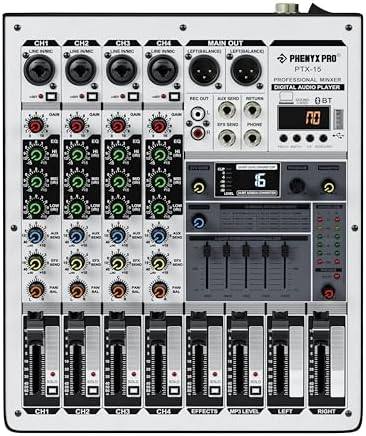
And then there's the Phenyx Pro sound console, which isn't a DJ controller at all, but it keeps showing up in the same search results. It's a professional audio mixer, and if you're looking for a 4-channel DJ controller, this isn't it. Skip it.
The bottom line
The GRV6 is the controller I'd buy if I were starting my 4-channel journey today. It's got the right balance of portability, features, and price, and it's the natural upgrade path from the FLX4. The FLX10 is the aspirational pick, the one you buy when you're ready to make a real investment and you don't mind the weight.
The RANE FOUR is for Serato loyalists who want the best stems engine. At ~$799, the GRV6 works out to ~$2.19 per day if you use it daily for a year, which is cheaper than a coffee habit and it won't make you jittery.