Eight years of club sets and five years of weddings taught me that a DJ controller comparison is never really about specs. It is about whether the software teaches you to mix or does the mixing for you, whether the jog wheels have enough resistance to trust with your eyes closed, and whether the faders will still be alive after a year of real cuts. So this DJ controller comparison puts three very different machines side by side: the Hercules DJControl Inpulse 200 MK2, the Pioneer DJ DDJ-REV5, and the Denon DJ PRIME GO+. I also kept one wildcard in the table, a plug-in temperature controller that has nothing to do with mixing and everything to do with keeping a gear room, a storage unit, or a kegerator from ruining your week.
The short version: the Pioneer DDJ-REV5 is the scratch-style pick for anyone raised on turntables, the Denon PRIME GO+ is the one to buy if you never want to plug in a laptop, and the Hercules DJControl Inpulse 200 MK2 is the best place to start. The fourth entry is not a controller at all, and I will explain why it earned a row.
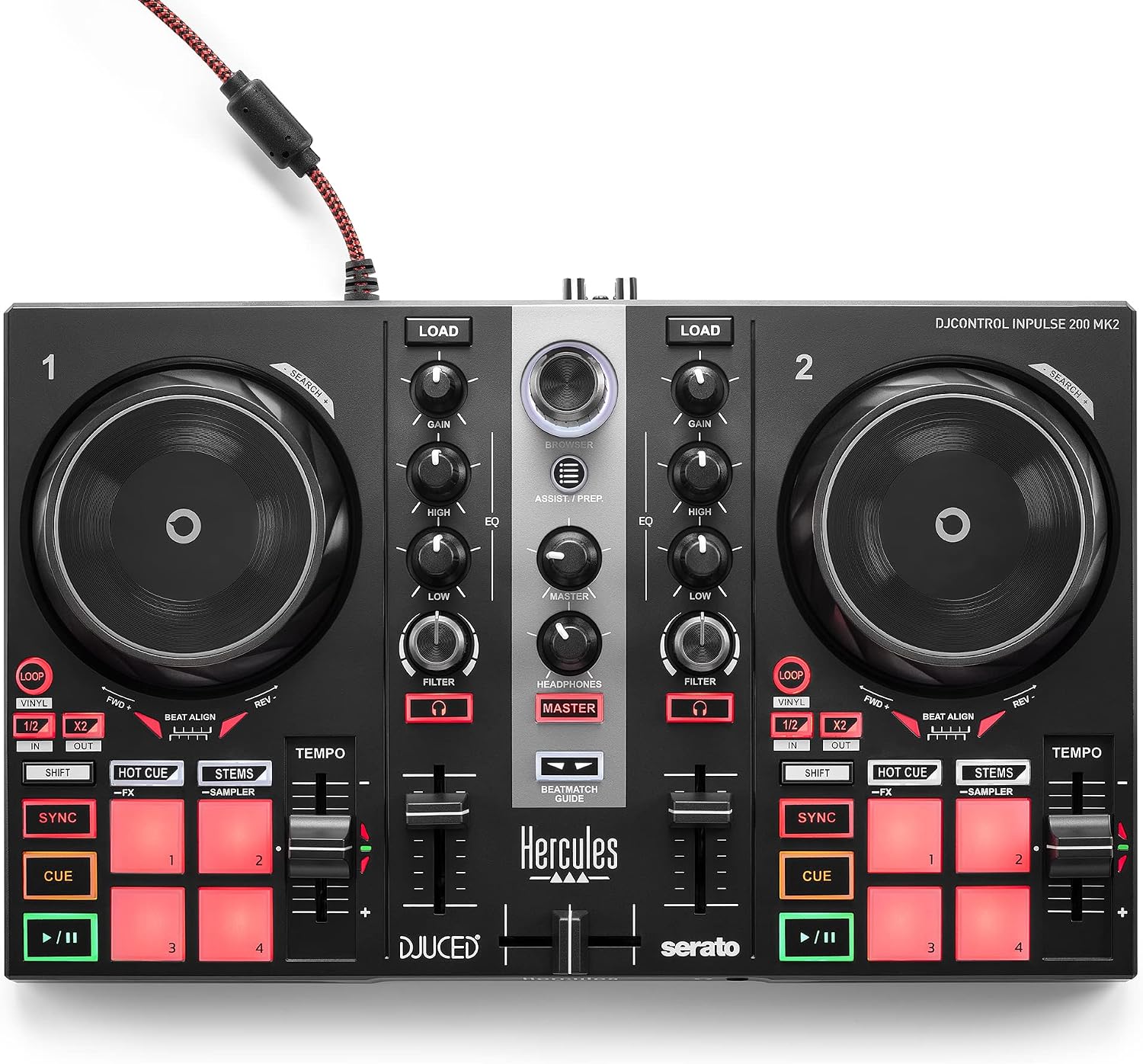
Hercules DJControl Inpulse 200 MK2
Ships with both Serato and DJUCED, compact enough for a kitchen table, assist features that teach instead of replace you
Small jog wheels, plastic chassis, two channels and limited I/O
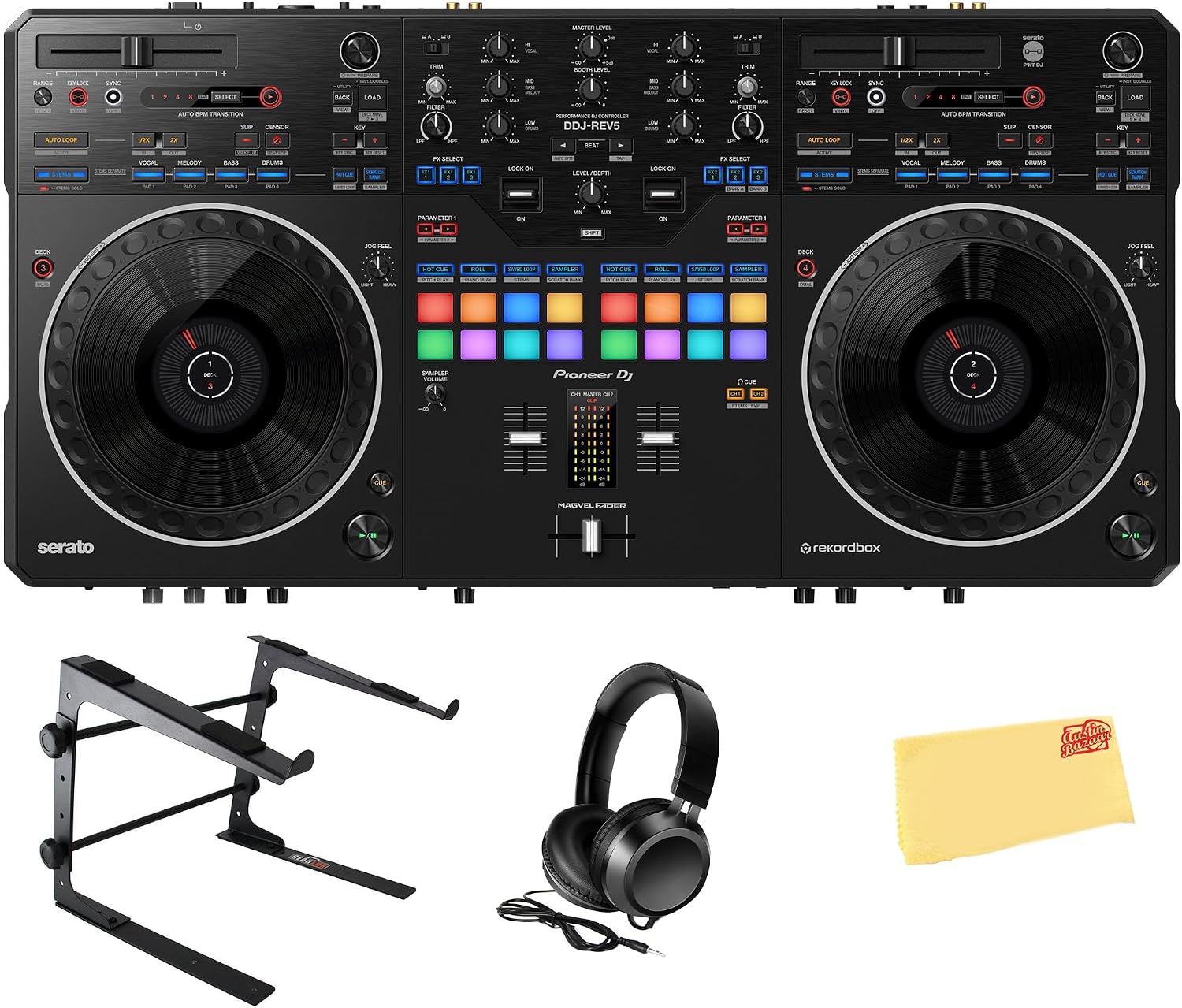
Pioneer DJ DDJ-REV5 Scratch-Style 2-Channel Professional DJ Controller Bundle
Scratch-style layout, the Rekordbox side of the ecosystem, useful laptop stand in the bundle
Still needs a laptop, still two channels, headphones and cloth in the bundle are filler
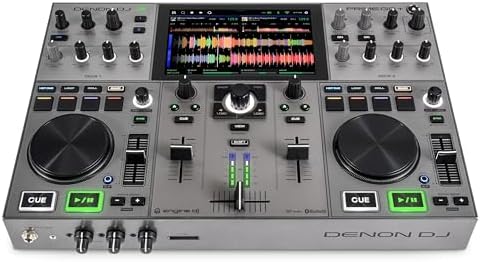
Denon DJ PRIME GO+ Standalone Portable DJ Controller
No laptop, one-bag setup, practice anywhere
You own the library management, less forgiving mid-set, costs more than a laptop-first rig
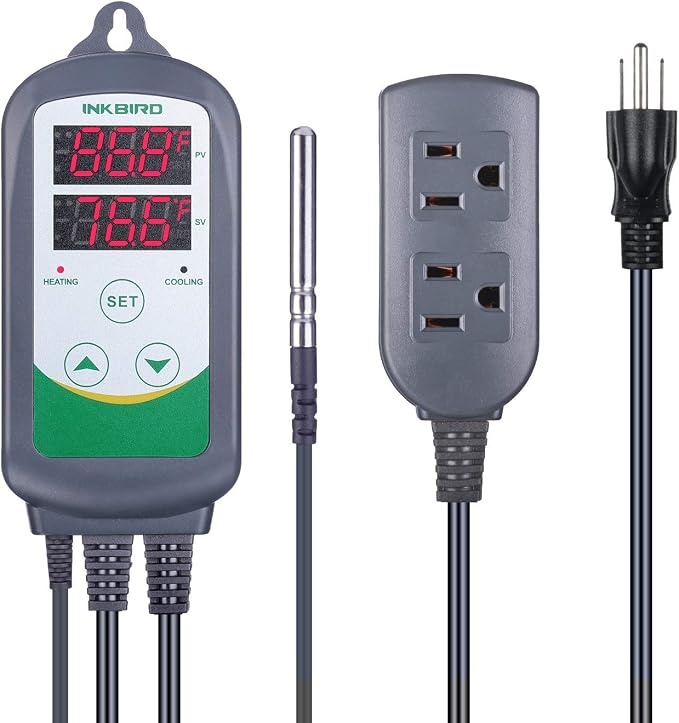
Inkbird ITC308 Freezer Thermostat Heating Cooling Plug Temperature Controller Outlet 110V 1200W
Holds a gear room, basement, or storage unit at a stable temperature
Not a DJ product, no software, needs a heater or cooler to actually do anything
Prices and availability were captured from Amazon Creators API and may change.
How I compare controllers
My criteria do not change between a beginner controller and a flagship one.
First, the software bundle. A controller is only as good as what it ships with, and a bundle that gates basic features behind a subscription is a permanent tax on a piece of hardware you already paid for.
Second, jog wheel feel. Size, resistance, and touch response matter more than any spec sheet number, because the wheel is what you touch for pitch bends on every single transition. Cheap plastic wheels make every mix feel like a mistake.
Third, faders. They die. The question is whether they die at a gig or after a long stretch of studio hours, and whether they can be replaced without shipping the whole unit back.
Fourth, channel count and I/O. Two solid channels and a brain that plans transitions will take you further than four channels you do not use yet.
Fifth, whether it needs a laptop at all. That single question changes your entire workflow, from how you prep to how fast you set up.
Hercules DJControl Inpulse 200 MK2: the starter that teaches
The Inpulse 200 MK2 is the smallest thing here and the one I would hand to a friend who has never touched a controller. Two channels, a footprint that fits beside a laptop on a kitchen table, and a software situation that does not punish you: it ships with both Serato and DJUCED. That dual bundle is the entire pitch. Serato is the ecosystem you will eventually meet in a booth, and DJUCED is the one that walks you through beatmatching with visual guidance and assist features instead of pretending you already know how. For a beginner, that combination is worth more than any hardware upgrade.
The assist features are the part I care about. A controller that teaches you to hear a mix is a controller you will outgrow in a good way, because you will leave it knowing something. A controller that does the mix for you is a controller you will still be leaning on three years later.
Where it loses: the jog wheels are small, and small wheels give you less surface area for fine pitch adjustments, so clean blends demand more attention. The chassis is plastic and light, which is great in a backpack and less great when a guest leans on the table. This is a bedroom and small-party controller. It is not a club controller and I will not pretend otherwise. Two channels and limited I/O also mean that the moment you want a third deck or a hardware effects unit, you have run out of road.
Pioneer DJ DDJ-REV5: the scratch-style standard
The DDJ-REV5 is a scratch-style, two-channel controller, and that description tells you who it is for. A scratch-style layout is built around cutting, juggling, and fast hand movement rather than around a straight-ahead club workflow. If you came up on turntables, or you spend your practice time on fader technique, ergonomics matter more than channel count, and this is the layout that rewards that.
The bundle deserves an honest read: laptop stand, headphones, polishing cloth. The stand is the useful piece, because a controller plus a laptop plus a bad table angle is how necks get wrecked on long nights. Headphones bundled with anything are usually the weakest link, and a cloth is a cloth, so treat those two as packing material rather than value. What you are actually paying for is the Pioneer layout and the Rekordbox side of the ecosystem, which is the standard you will find in most booths you walk into. The industry standard is the standard for a reason.
The trade-offs are straightforward. It still needs a laptop, so your setup is a bag plus a computer plus a stand. It is still two channels, so anyone who wants four decks or heavy effects routing should look elsewhere. And it carries the brand premium that comes with the name on the front. If scratch technique is your priority and you already live in Rekordbox, none of that is a problem.
Denon DJ PRIME GO+: the standalone option
The PRIME GO+ is the outlier in the best way. It is standalone and portable, which means no laptop at all. That changes how you prepare and how you play: you load your library onto the device, you carry one bag, and you set up in minutes. For mobile work, weddings, and anything where setup time is the difference between a soundcheck and a scramble, that is a genuine advantage rather than a marketing line. Portability also means you can practice anywhere, and for a beginner that is more valuable than most people admit.
Where it loses: standalone means you own your library management. Every track has to be analyzed and organized on the device or in the desktop software that feeds it, and if you are coming from a laptop-first workflow, that is a real adjustment period. It is also the least forgiving option if something goes wrong mid-set, because there is no second computer sitting there as a fallback unless you bring one. And you are paying for the convenience of not carrying a laptop, so that convenience has to actually matter to you.
Inkbird ITC308: the wildcard that protects the gear
Now the odd row. The Inkbird ITC308 is a plug-in temperature controller. You plug it into the wall, plug a heater or a cooler into it, place the probe where you want the temperature read, and it switches that outlet on and off to hold your target. The listing names greenhouses, heaters, coolers, reptile enclosures, brewing, fermentation, and kegerators, and it handles heating and cooling on a 110V outlet rated to 1200W.
Why is it in a DJ controller comparison? Because gear lives somewhere, and that somewhere is usually a garage, a basement, or a storage unit with no climate control. Temperature swings are how rubberized knobs turn tacky, how a spare controller you forgot about becomes a spare controller you cannot trust, and how a kegerator at the after-party gets warm. If your practice room doubles as a garage, this is the least expensive insurance in this article.
It is not a DJ product. It has no software, no faders, and no jog wheels, and it will not help you mix. It only makes sense if you have a heater or cooler to switch and a room worth protecting. But for a lot of home setups, that is exactly the missing piece.
Software is half the value
Rank the three controllers by hardware alone and you will buy the wrong one. The bundle decides how fast you improve.
Serato and DJUCED on the Hercules give you a path: learn on the guided software, move to the one the booths use, and keep the muscle memory you built. Rekordbox on the Pioneer side means the library you build at home is the library you plug into at a venue. The Denon standalone workflow means your library lives on the device and travels with it, which is wonderful until you have to re-analyze a large collection for a different ecosystem.
Subscriptions are the trap to watch for. If basic features need a monthly payment on hardware you already own, factor that into the real cost before you buy, not after.
Jog wheels and faders are what actually die
Two failure points kill controllers: wheels that never felt good in the first place, and faders that wear out after aggressive cutting. The Hercules wheels are small, which is a beginner-friendly compromise and a ceiling for fine work. The Pioneer scratch-style layout is aimed squarely at people who use the fader constantly, so fader durability is the question worth asking there. The Denon puts its money into the standalone brain and portability, which means the wheels are a supporting actor rather than the star.
When you buy, ask one question: if this fader dies in fourteen months, can I replace it, or is the whole unit scrap? That answer matters more than any feature list.
Two channels, or no laptop at all
The Hercules and the Pioneer are both two-channel controllers that need a laptop. The difference is the layout and the software. The Denon is a two-channel-ish standalone unit that needs nothing but power and your library.
So the real decision is not Hercules versus Pioneer versus Denon. It is laptop-first versus standalone, and layout versus portability. Answer that, and the shortlist collapses on its own.
Which one should you buy
If you are brand new and practicing every night, the Hercules DJControl Inpulse 200 MK2 is the right first controller. It costs the least, it teaches, and it will resell when you upgrade.
If you came from turntables or you live on fader technique, the Pioneer DDJ-REV5 is the scratch-style pick, and the Rekordbox ecosystem is the standard you want in your library anyway.
If setup time is money, the Denon DJ PRIME GO+ is the one bag, no laptop answer for mobile work and weddings.
And if your gear lives in a garage or a storage unit, the Inkbird ITC308 is not a controller, but it is the reason your controller still works next winter.
What I am watching next
Jog wheel durability is the thing I keep coming back to, because it is the part of a controller you cannot upgrade. I am also watching how standalone libraries mature, since the whole case for skipping a laptop rests on library management being painless. Until that changes, the honest advice is the same as always: buy the controller whose software you will actually open tomorrow, and keep the room you practice in within a sane temperature range.