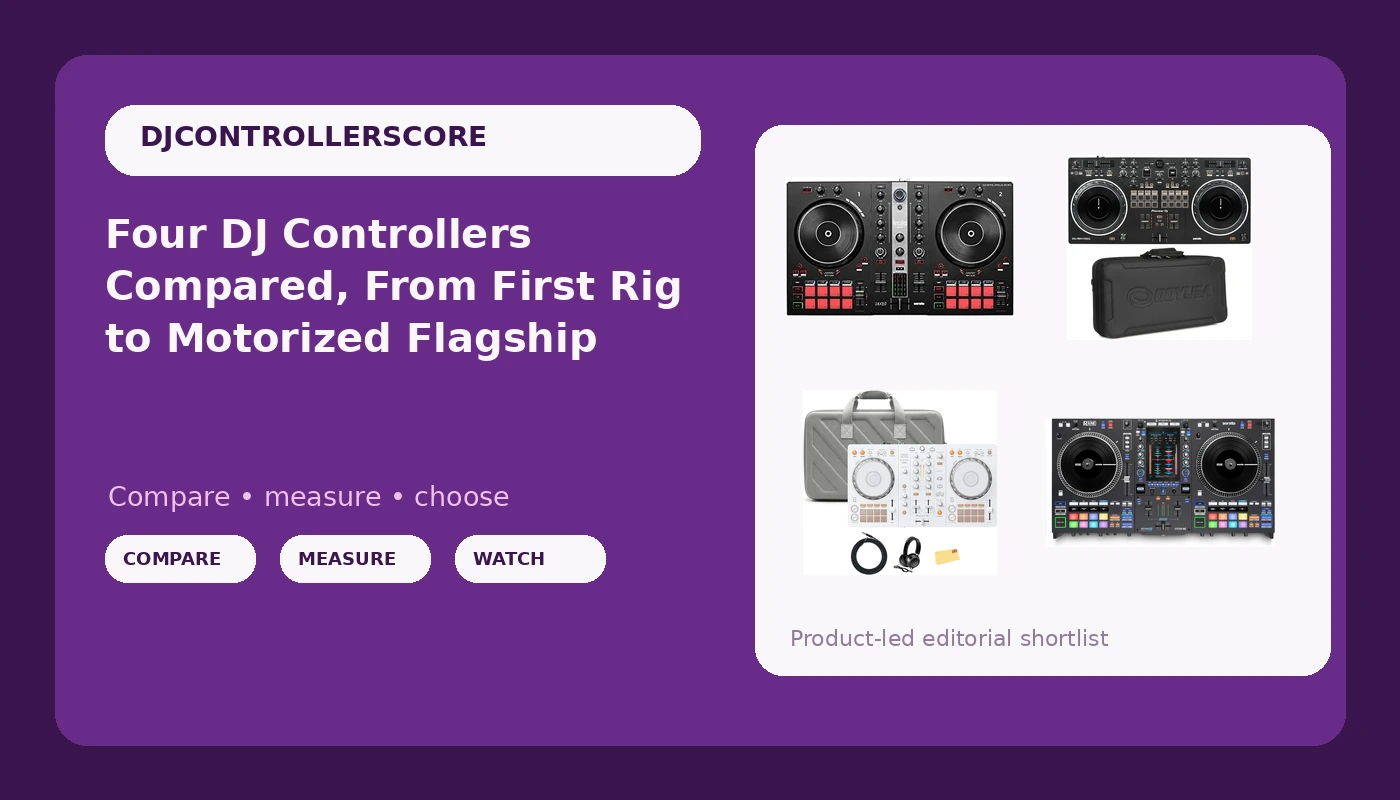
I have been behind club rigs in Brooklyn for eight years and behind wedding setups for five, and the question I hear most from people who want to learn is never "which controller is best." It is "which controller will I still be using in a year." That is a harder question, and it is why this comparison of DJ controllers for every budget starts with software bundles and fader feel instead of a feature checklist. Four units sit in this roundup: a budget two-deck starter, a Serato-first scratch deck, the bundle most beginners end up buying, and a motorized standalone flagship that costs more than most people's first car payment.
The gap between these four is not really about channel counts. It is about what each one assumes you already own. Two of them assume you own a laptop and are willing to learn software. One assumes you want to scratch. One assumes you are done with laptops entirely. Pick the one that matches your actual life and you will practice every night. Pick the wrong one and it will live in a closet by February.
Related: Rekordbox vs Serato: Which Software Should You Learn First
For most people reading this, the Pioneer DJ DDJ-FLX4 bundle is the answer, because rekordbox comes with it, the two channels are enough to learn on, and it holds its resale value better than anything else in this price bracket. The other three exist for specific people: the Hercules for the tightest budget, the DDJ-REV1 for scratch-first Serato players, and the RANE SYSTEM ONE for anyone who never wants to open a laptop again.
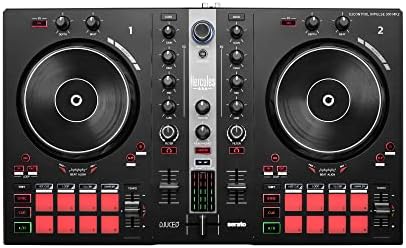
Hercules DJControl Inpulse 300 MK2-2-Deck DJ Controller Serato & DJUCED
Cheapest real path into DJing, ships with two software options, and the beat assist teaches beatmatching instead of hiding it
Two decks only, plastic-heavy build, and the crossfader is not something I would trust at a paying gig
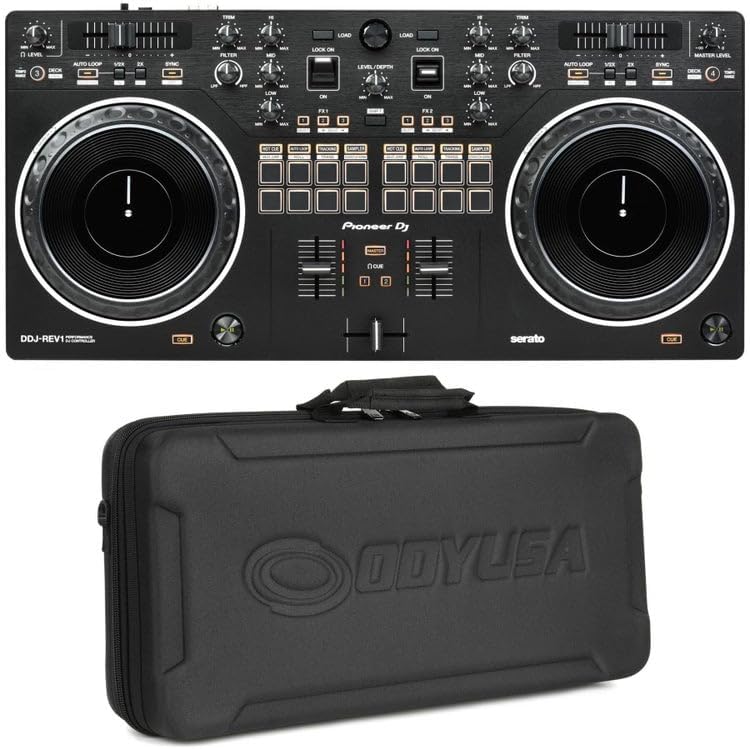
Pioneer DJ DDJ-REV1 2-deck Serato DJ Controller with Carry Case
Scratch-oriented layout, Serato in the name, and the carry case is included instead of sold separately
Serato is a paid path if you outgrow the bundled tier, and the layout is odd for straight mixing
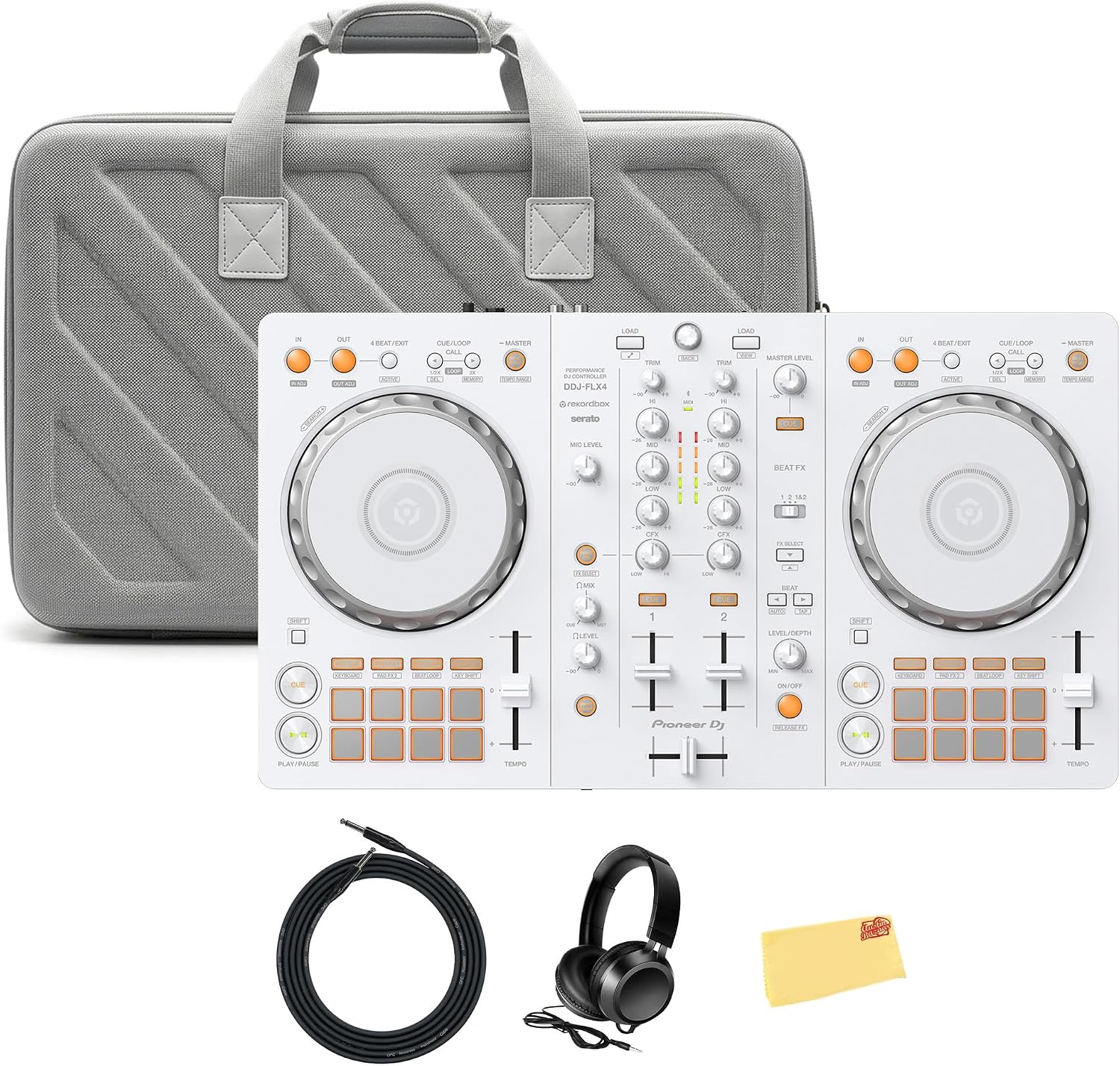
Pioneer DJ DDJ-FLX4 2-Channel DJ Controller - White Bundle with Carrying Case, Headphones, Instrument Cable, and Austin Bazaar Polishing Cloth
The best gateway drug in DJing: rekordbox included, usable jog wheels, and it resells easily when you upgrade
White finish shows every fingerprint, and two channels is a ceiling you will hit within a year if you fall in love
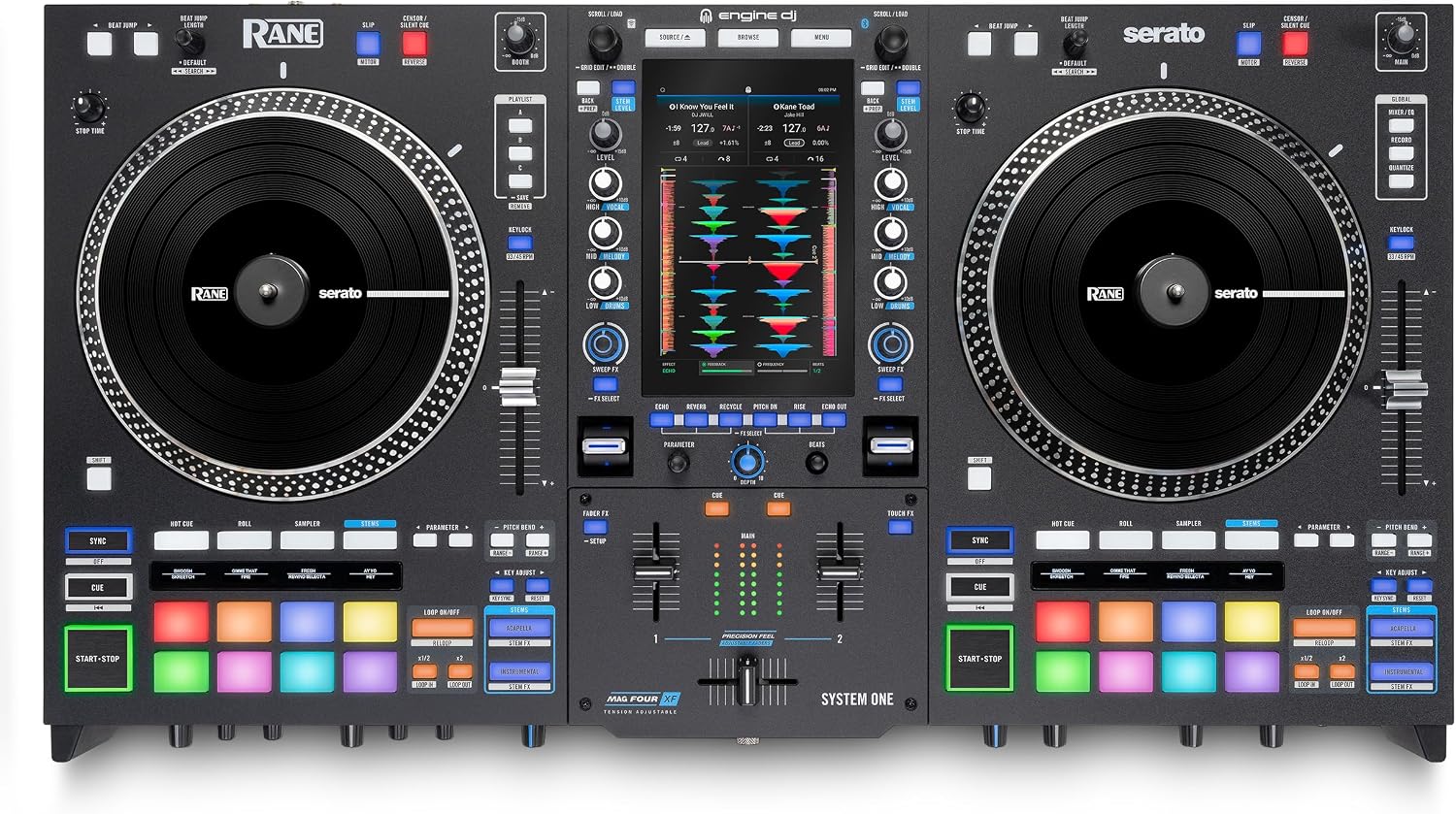
RANE SYSTEM ONE Motorized Standalone DJ Controller
Motorized platters and no laptop required, which is the closest a controller gets to turntable feel
Flagship money, serious weight, and absolute overkill as a first purchase
Prices and availability were captured from Amazon Creators API and may change.
How I judge a controller
Before any controller earns a recommendation from me, it has to answer four questions. First, can it survive a full-length set, meaning four hours of real transitions, not twenty minutes of messing around in a bedroom? Second, how do the jog wheels feel with my eyes closed? If I cannot feel the platter under my fingers, the mix will feel like a guess. Third, what software does it bundle, and is that software going to cost me again in six months? Fourth, would I trust the faders at a gig where people paid to get in?
Notice that none of those questions are about channel count, pad count, or how many RGB lights are on the faceplate. A controller is a tool for transitions. Everything else is decoration, and decoration does not save you when the room is full and the next track needs to come in on the one.
Software is half the purchase
The bundle is where these four separate fastest. The DDJ-FLX4's entire pitch is that rekordbox comes with it, and that matters more than any spec on the box. Rekordbox is what the clubs in my neighborhood run, so the library you build on a FLX4 at home is the same library you plug into a CDJ setup later. That continuity is worth more than the money you save buying a cheaper deck with weaker software.
The DDJ-REV1 lives on the Serato side of the house, which is a legitimate choice and not a consolation prize. Plenty of working DJs never touch anything else. The catch is the tiering. Before you commit, check whether the software level you actually need is a one-time purchase or a subscription, because paying monthly for basic features on a controller you already own is one of my least favorite trends in this industry.
The Hercules DJControl Inpulse 300 MK2 ships with both DJUCED and Serato, which is genuinely unusual at the entry level. That gives you a way to try both ecosystems without buying twice. It is the cheapest of the four, and it is the one I would hand to a teenager who is not sure yet whether DJing is a hobby or a phase.
The RANE SYSTEM ONE removes the question entirely. It is standalone, so there is no laptop, no library to migrate, and no software subscription to argue with. You plug it into a sound system and play.
Jog wheels and faders, the eyes-closed test
Close your eyes and touch the jog wheel. That is the review. Jog wheel feel is the soul of a controller, and it is the first place budget hardware gives itself away. Wheels with no resistance make every pitch bend feel like a mistake, and wheels with cheap plastic edges make scratching sound like you are fighting the gear instead of playing it.
On the Hercules, the wheels are serviceable for learning and that is the honest ceiling. On the FLX4, they are good enough that I would not think about them during a set, which is the highest compliment I can give a controller at that level. The DDJ-REV1 is built around the assumption that you will be touching the platters constantly, so the layout puts the controls where your scratching hand expects them.
The RANE SYSTEM ONE is a different category of object because the platters are motorized. That means the wheel turns on its own the way a turntable does, and your hand fights and guides it instead of spinning it manually. If you came up on vinyl, this is the thing you have been missing on every other controller. If you did not, it is a heavier, more expensive, more physical way to mix, and you should know that before you spend flagship money.
Faders are the other half. Faders die. The question is whether they die at a gig or after 500 hours in the studio. Budget crossfaders get sloppy after a year of aggressive cuts, and you can feel the mush long before you can hear it. If you plan to cut and scratch seriously, buy for the fader, not for the pad lights.
Two channels is enough, until it is not
You do not need four channels to start. You need two solid channels and a brain that plans transitions. Two channels forces you to think about where a track is going before you load it, which is the actual skill. Four channels mostly lets you hide indecision behind a third deck you never use.
Both the Hercules and the FLX4 are two-channel units, and that is not a flaw at this stage. The ceiling arrives later, usually around the time you start wanting to layer an a cappella or a loop over a track that is already playing. When that day comes, you will know, and you will also know exactly what you want next. Buying four channels before you have that instinct is how people end up with gear they never learned to use.
The standalone argument
The RANE SYSTEM ONE is the only one here that never needs a computer. That sounds like a luxury until you have watched a laptop overheat at a wedding, or watched a USB cable fail mid-set at a bar gig with no backup plan. Standalone means the thing either works or it does not, and there is no operating system in between you and the music.
The trade-offs are real. It is heavy, it is the most expensive option in this group by a wide margin, and the learning curve is steeper because you are managing your music on the device rather than dragging files around on a screen. It is also not a beginner purchase. It is what you buy after you have decided that DJing is not a phase and you want the tactile version of the craft.
What the bundles actually get you
The DDJ-FLX4 white bundle is the most complete box here: the controller, a carrying case, headphones, an instrument cable, and a polishing cloth. That means you can unbox it and play a house party without ordering three more things, which is a bigger deal than it sounds when you are budgeting for your first setup. The white finish is the one thing I would think twice about, because a controller that lives in a bag picks up grime, and white shows all of it.
The DDJ-REV1 includes a carry case, which puts it in the same practical territory. The Hercules ships with software and not much else, so plan on buying a case and a decent pair of headphones separately. The RANE needs nothing, which is part of what you are paying for.
Whichever you choose, budget for one extra purchase: a case you actually use. Controllers do not break because they are cheap. They break because they ride loose in a trunk.
Which one should you buy
If you are starting from zero and you want the safest possible first purchase, buy the DDJ-FLX4 bundle. Rekordbox is included, the jog wheels are genuinely usable, and if you quit in six months you can sell it and recover a meaningful chunk of what you spent. Pioneer did not become the industry standard by accident, and the resale market proves it.
If money is the hard constraint, buy the Hercules DJControl Inpulse 300 MK2. It is the best beginner feature set in this group because the beat assist actually teaches you instead of doing the work for you, and it gives you two software ecosystems to try. Just accept that the faders are the first thing you will outgrow.
If you already know you want to scratch, buy the DDJ-REV1. The layout exists for that purpose, the carry case is included, and Serato is a legitimate long-term home. If you are a former turntable person who wants that motorized feel without a laptop, the RANE SYSTEM ONE is the only answer on this list, and it is worth the weight.
What I'm testing next
Jog wheel durability is the thing I care about most in 2026, and it is the thing no spec sheet tells you. I am running units through full set lengths and a fader stress test that would void any warranty, because the only meaningful question about a controller is whether it still feels right in month eighteen. That report is coming. In the meantime, buy the controller that matches the DJ you are actually becoming, not the one in the marketing photos.