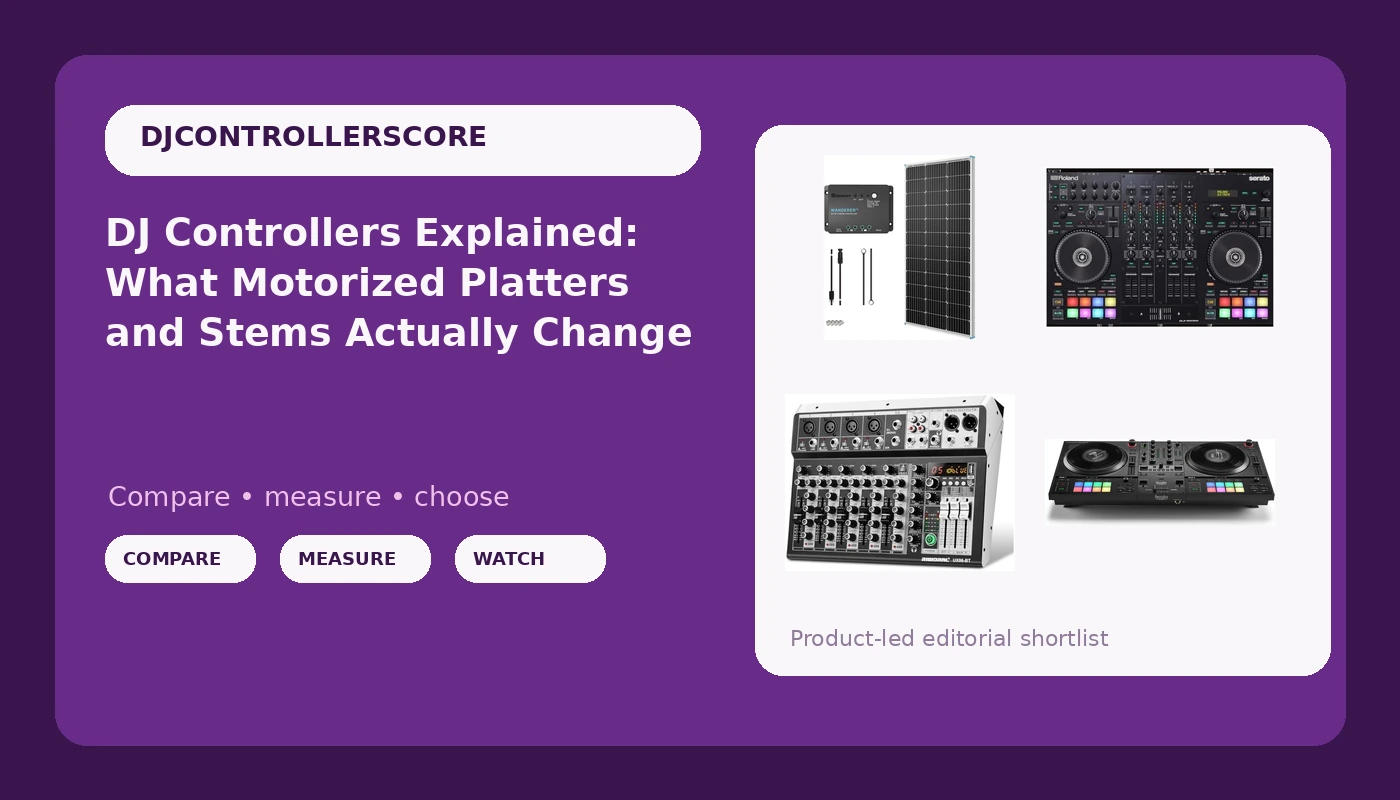
Search for a DJ controller and the results page hands you two completely different kinds of hardware under one word. There are the decks you actually mix on, and then there are charge controllers, compact mixers, and audio interfaces that borrowed the name. This DJ controller buying guide separates them. It explains what the specs on a listing actually change about a set, where motorized platters and stems control fit into daily practice, and which of the four options here matches the job in front of you. Nothing below leans on a price, because prices move and the hardware does not.
Related: Rekordbox vs Serato: Which Software Should You Learn First? →
Quick answer
The Hercules DJControl Inpulse T7 is the only option in this group with motorized platters and built-in stems control, and it includes Serato DJ and DJUCED, so it is the one to examine if you want moving platters under your hands. The Roland DJ-707M is the option designed for live streamers and content creators, which suits a setup that runs through a broadcast as much as a booth. The 6 Channel Audio Interface Sound Board Mixing Console is a small-format mixer for microphones, karaoke, and streaming rather than a DJ controller. The Renogy 100W 12V Solar Panel Starter Kit is a solar panel paired with a charge controller, and it shares only the word with the rest of this list.
Four useful options
| Model | Best fit | What stands out |
|---|---|---|
| Hercules DJControl Inpulse T7 | DJs who want moving platters and stems control | Two motorized decks, built-in stems control, Serato DJ and DJUCED included |
| Roland DJ-707M | Live streamers and content creators | A controller layout designed around stream and content workflows |
| 6 Channel Audio Interface Sound Board Mixing Console | Small setups mixing mics with music | Six channels, 16-bit DSP, reverb effect, +48V phantom power, Bluetooth |
| Renogy 100W 12V Solar Panel Starter Kit | Off-grid power, not DJing | 100W panel paired with a 30A PWM charge controller |
The motorized-platter option: Hercules DJControl Inpulse T7
Motorized platters are the dividing line in this category. They rotate under your fingers, so a pitch bend or a scratch responds to the same motion you would use on a turntable, and your hands learn the position of the platter without a glance. That is also the trade-off: moving platters mean mechanical parts, more weight in the bag, and a higher entry point than a controller with static wheels. Two decks keeps the layout focused, which is the right call if you mix two tracks at a time and wrong if your sets run four sources. The software bundle carries real weight here, since Serato DJ and DJUCED are both included and you are not shopping for a second purchase before your first session.
The streaming option: Roland DJ-707M
When a set is watched rather than danced to, the priorities shift. You are managing a microphone, a stream feed, and music at the same time, and the layout has to survive you talking to camera mid-transition. The DJ-707M is the option here that names that audience directly instead of treating streaming as an afterthought. The trade-off runs the other way too: a controller built around broadcast workflows may carry features you never touch if your gigs are rooms full of people and nothing else.
The small-format mixer option: 6 Channel Audio Interface Sound Board Mixing Console
This is the entry that is not a DJ controller, and the listing says so once you read past the word mixer. There are no decks, no jog wheels, and no transport controls. It takes microphones and line sources, applies effects, and sums them into one output. That makes it useful for a karaoke night, a podcast, a two-person stream, or any setup where a host mic has to sit on top of music. The trade-off is obvious: without decks you still need something else to play and beatmatch the tracks, so this is an addition to a rig rather than the center of one.
The other kind of controller: Renogy 100W 12V Solar Panel Starter Kit with 30A PWM Controller
It belongs in this article for one reason: the word controller. A charge controller regulates power flowing from a solar panel into a battery, which is a real job and an entirely different one from cueing a track. Search results blend the two, so it pays to know which category you landed in before you compare features. It is worth a look only if you are powering a remote setup, like a trailer party, a pop-up in a park, or an outdoor stream with no outlet nearby. If you are buying gear to mix on, this is not it.
Prices and availability may change. Product images, names, and retailer links must be matched by verified ASIN. Do not state a current price, rating, stock status, or measured result without current evidence.
What motorized platters change about practice
A jog wheel is the surface you touch to nudge a track, bend its pitch, or scratch. On most controllers it is a touch-sensitive wheel that does not spin on its own, so your hand provides all the motion and the wheel reports position back to the software. Motorized platters flip that. The platter rotates with the track and stops when the track stops, which means the surface behaves like a turntable and your hand learns to ride it instead of tapping it.
The practical difference shows up in three places. Pitch bends feel like the ones you already know from vinyl, because the platter is physically moving under your palm. Scratching has resistance and momentum, so you are pushing against something rather than sliding across a sensor. And your hand finds the platter in the dark, which matters in a booth where you are watching a crowd instead of your gear. The cost is mechanical: more parts to wear, more weight to carry, and a design that generally costs more than a static-wheel equivalent. Motorized platters do not teach you to beatmatch, and they do not fix a transition that was planned badly. They change how the instrument feels, and feel is what you practice on every night.
What stems control adds at the hardware level
Stems separate a finished track into parts, typically vocals, drums, bass, and everything else. The software does the separation, but the controller decides how much of that you can reach without touching the laptop. Built-in stems control means buttons or knobs on the hardware are mapped to those parts, so you can mute a vocal live, drop the bass for a breakdown, or hold an instrumental while a vocal rides over it.
That capability changes set construction more than it changes any single transition. You can stretch a section, isolate an acapella, or rebuild a track on the fly instead of hunting for an edit. How well it works depends on software support, on how clean the separation sounds on your material, and on the laptop driving it. Treat stems as a live tool you rehearse with, not a button that rescues a mix.
Five steps keep the decision grounded:
- Decide what the gear has to do on a normal night: two-deck mixing, multi-source routing, or a broadcast with a host microphone.
- Check which software ships with the hardware and whether that software matches the library you already own.
- Put your hands on the jog wheels or platters before you commit, if any shop near you has a unit on display.
- Read the listing for the features you will use weekly rather than the ones in the marketing photo.
- Leave room in the budget for the unglamorous parts: cables, a stand, headphones, and a case.
Practical guidance for matching gear to the gig
- Two solid channels and a plan for your transitions will carry you further than a fourth channel you never route.
- If your sets are streamed, weigh microphone routing and phantom power before you weigh platter design.
- Motorized platters add weight, so measure your bag and your back before you commit to carrying them weekly.
- The bundled software shapes your first month of practice more than any spec line on the box.
- If a listing called a controller has no decks and no jog wheels, you are looking at a mixer or a power device, and the shopping decision is a different one.
Which option should you choose?
Choose the Hercules DJControl Inpulse T7 when you want motorized platters and stems control and you mix two decks at a time. Choose the Roland DJ-707M when your sets are built for a stream audience and the controller has to live alongside a microphone and a broadcast. Choose the 6 Channel Audio Interface Sound Board Mixing Console when you need a compact mixer for microphones, karaoke, or streaming audio and you already have a separate source for the music. Choose the Renogy 100W 12V Solar Panel Starter Kit when the job is off-grid power for a remote setup, not DJing at all.
Every claim above comes from the product listings themselves. None of these units was put through a live set for this article, so treat the feature lists and software bundles as a starting point and confirm the current details on the product page before you buy.
The bottom line
The word controller covers a lot of ground, and the fastest way to shop is to sort the listings by the job they do. For mixing, the meaningful split in this group is motorized platters and stems control on the Hercules DJControl Inpulse T7 against a streaming-first controller layout on the Roland DJ-707M. The 6 Channel Audio Interface Sound Board Mixing Console covers the microphone and routing side of a small setup without pretending to be a deck, and the Renogy kit is a power device that happens to share a noun. Pick the tool that matches the night you actually play, check what software comes in the box, and let the feel of the platters make the final call.