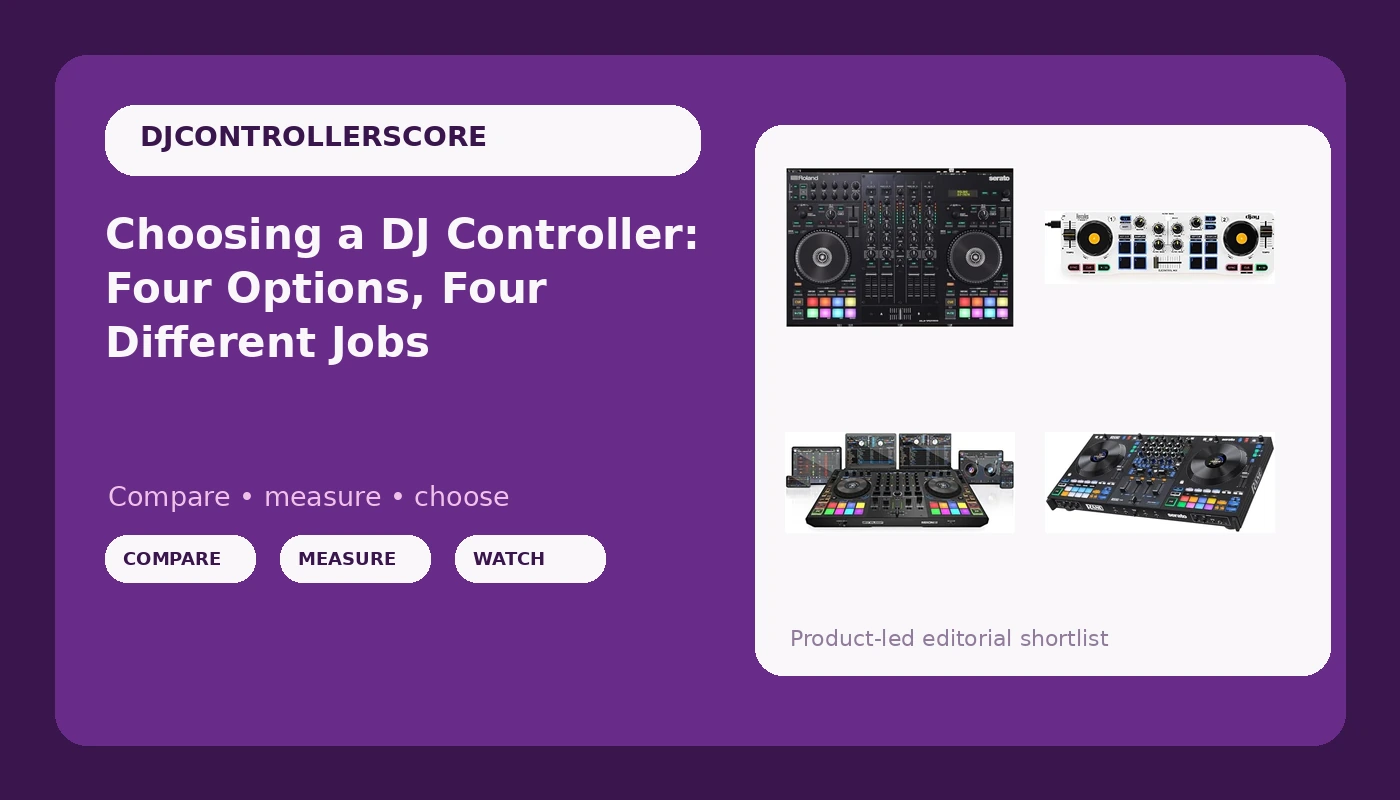
Choosing a DJ controller looks like a spec-sheet problem, and it is not. Two controllers can list the same channel count and the same number of pads and still feel like completely different instruments the moment you put your hands on them. What actually decides whether you keep playing is the software the controller ships with, how the jog wheels feel under your fingers, and whether the inputs on the back match the room you play in. This explainer covers four verified controllers that solve four genuinely different problems, plus the questions that separate them.
Related: How to Read a DJ Controller Spec Sheet Without Getting Fooled →
Quick answer
There is no single best DJ controller, because the right answer depends on your software and the rooms you play. If you work in Serato and want stems controls within reach during a set, the RANE FOUR is built for that. If you need four channels and a mixer-style section for a setup that stays in one place, the Reloop Mixon 8 Pro is the closest comparison. If you stream, run events, or juggle microphones and decks in the same set, the Roland DJ-707M was designed around that job. And if you are learning on a phone or tablet with no laptop involved, the Hercules DJControl Mix is the entry point. The rest of this article explains who each one suits and what you give up.
Four useful options
| Model | Best fit | What stands out |
|---|---|---|
| RANE FOUR Professional Stems DJ Controller | Serato-based stems performance | Four-channel layout with stems controls on the surface |
| Reloop Mixon 8 Pro 4-Channel DJ Controller, Black | Multi-deck mixing in a fixed setup | Four-channel layout with a mixer-style section |
| Roland DJ-707M DJ Controller for live streamers and content creators (DJ-707M) | Streaming, event, and mobile work | Inputs aimed at mics and external audio sources |
| Hercules DJControl Mix, Bluetooth Wireless DJ Controller for Smartphones (iOS and Android), dJay app, 2 Decks, White | Phone and tablet practice | Wireless Bluetooth connection and a dJay app workflow |
Stems performance: RANE FOUR Professional Stems DJ Controller
The trade-off here is scope. A four-channel, stems-first controller is a lot of surface area, and the extra channels only pay off if your sets actually use them. Stems also rewards preparation: knowing which parts of a track you want to isolate is a skill you build by practicing, not a feature that plays itself. If your sets are two decks and clean transitions, you are paying for capability you may not touch for a year.
Four channels, one room: Reloop Mixon 8 Pro 4-Channel DJ Controller
The trade-off is footprint and weight. A four-channel, mixer-style controller takes up more desk than a two-deck unit, and the extra routing only helps if you have something to plug into it. This is also the kind of controller that tends to stay in one place rather than travel to every gig, so it suits a home booth or a venue install more than a bag you carry on the subway. If you mostly play two decks and a phone, this is more desk than you need.
Streaming and events: Roland DJ-707M DJ Controller for live streamers and content creators (DJ-707M)
The trade-off is that streaming-focused routing is only valuable if you stream or run events. If you play in rooms with a house mixer and a single pair of RCA cables, you are carrying audio options you never touch. This is a controller for DJs who want the hardware to take on more of the audio work so the software can stay focused on mixing, and that is a specific job rather than a universal upgrade.
Phone-first practice: Hercules DJControl Mix, Bluetooth Wireless DJ Controller for Smartphones (iOS and Android), dJay app, 2 Decks, White
The trade-off is scale. Two decks on a phone-sized controller is not the same as a full club layout, and a wireless connection is a convenience rather than a stage rig. What it buys you is nightly practice: fifteen minutes before bed, a playlist, and a place to learn beatmatching and phrasing without a laptop and a desk. For a beginner, that repetition matters more than channel count.
Prices and availability may change. Product images, names, and retailer links must be matched by verified ASIN. Do not state a current price, rating, stock status, or measured result without current evidence.
What actually matters when you compare DJ controllers
Software bundles matter more than most spec sheets admit. A controller is only as good as the software it ships with, because the bundle decides what you can practice tonight and what you will have to pay for later. Serato DJ Pro, rekordbox, and djay Pro each have their own logic, and a subscription you did not plan for changes the real cost of a cheap controller.
Jog wheel feel is the second thing, and it is the one a spec sheet cannot carry. Resistance, size, and the way a platter responds to a light touch decide whether a pitch bend feels like a correction or a mistake. If you can put your hands on a controller before buying, do that first. If you cannot, prioritize units with larger platters and read the details carefully.
Faders are the third. Crossfaders and channel faders are mechanical parts with a service life, and they are usually the first thing to go. How a fader feels on day one is not a durability test, but a loose, plasticky feel is not a promising start either.
Channel count is the fourth, and it is the most oversold. You do not need four channels to start. You need two solid channels and a brain that plans transitions. Four channels earn their space when you run acapellas, loops, or a third deck, or when you plug external sources into a mixer section.
Finally, count the inputs and outputs. Microphones, booth outputs, recording, and auxiliary sources are the difference between a controller that fits your room and one that needs a workaround every week.
How to decide in five steps
Work through these in order, because each answer narrows the next question.
- Name the software you already use, or the one you intend to learn, and treat it as the fixed point.
- Count the channels your sets actually use, not the channels you imagine using one day.
- List every input you need: microphones, guest devices, auxiliary sources, recording.
- Decide whether the controller travels or stays in one place, because weight and footprint follow from that.
- Set a budget that includes a case, cables, and headphones, not just the controller.
Practical guidance
- Read the software bundle before the hardware specs, since a license you will not use is money spent twice.
- Put your hands on the jog wheels if you can; resistance and size matter more than pad count.
- Match channel count to the sets you play now, and let upgrades happen when you outgrow them.
- If you stream or run events, count your inputs before you count your decks.
- Budget for the case and the cables in the same purchase, because a controller without them stays home.
Which option should you choose?
Choose the RANE FOUR Professional Stems DJ Controller when you already work in Serato and want stems controls within reach during a set. Choose the Reloop Mixon 8 Pro 4-Channel DJ Controller when you mix more than two sources in a setup that stays in one place. Choose the Roland DJ-707M DJ Controller for live streamers and content creators (DJ-707M) when your sets involve microphones, guests, and a broadcast alongside the decks. Choose the Hercules DJControl Mix when you are learning on a phone and need nightly practice more than a full layout.
One caveat applies to all four: a controller does not fix bad transitions, and the bundle matters as much as the box. Details like bundled software versions and included cables can change between production runs, so confirm the specifics on the product page before you commit.
The bottom line
Work backwards from your software and your room. If Serato and stems are the center of your sets, the RANE FOUR is built for that. If four channels and a mixer section describe your desk, the Reloop Mixon 8 Pro is the comparison to make. If streaming and events are the job, the Roland DJ-707M was designed for it. And if you are starting on a phone with no laptop, the Hercules DJControl Mix keeps cost and friction low while you build the skill that actually matters. Gear is not the bottleneck. Practice is.