Related: Best DJ Controllers for Tight Booths and Small Rooms
The best DJ controllers for every setup is a shortlist, not a single winner, and anyone who hands you one answer is selling something. I have played 200-capacity basements, wedding receptions with one usable outlet, and a 4,000-person warehouse where my hands did not stop shaking for the first twenty minutes. The box that works in those three rooms is not the same box. Pretending otherwise is how people end up fighting their gear every Saturday instead of reading the room.
So I am not sorting these four by a spec sheet. I am sorting them by the job. Who is standing behind it, where does the laptop live, how long is the set, and what happens when a fader dies at 1 a.m. with three hundred people watching. That last one is not hypothetical. Faders die. The only question is whether they die at a gig or after five hundred hours in a bedroom.
Four controllers, four different answers.
Best Overall: RANE SYSTEM ONE Motorized Standalone DJ Controller
Standalone is the word doing the work in that name. No laptop, no dongle, no driver update five minutes before doors. You plug in, you play, and the machine is the whole rig. For anyone who has watched a laptop refuse to wake up mid-set, that is not a small feature. It is the entire pitch.
The other word is motorized. A motorized platter behaves differently under your hand than a static jog wheel, and if you came up on turntables, that difference is muscle memory rather than luxury. Close your eyes and touch it. If your hand already knows what to do, the gear disappears, and that is what you are paying for at this level.
This is the pick for a DJ whose gigs are the job: clubs, weddings with real budgets, corporate work, anywhere the gear travels in a case and comes out twice a week. The trade is obvious. It costs like a flagship, and it is heavier than anything you would throw in a backpack for a favor gig.
Best for Streaming Rooms: Roland DJ-707M DJ Controller for Live Streamers and Content Creators
The name tells you exactly who this is for: live streamers and content creators. That is a genuinely different job from a club booth. In a booth you face a crowd and nobody sees your hands. On a stream, the hands are the show, the audio has to be clean for people listening on laptop speakers, and you are often talking over your own mix.
Roland has been building gear for people who make sound for a long time, and this unit sits in that lineage. What matters when you are shopping it is layout: can you run your show and your mix at once without reaching across the unit and knocking a fader with your forearm? Reach matters more than channel count on a stream, because you are doing two jobs with one set of hands.
If your week is three club nights and one stream, buy for the club. If your week is four streams and one party, buy for the stream. The person who has to look at your setup on camera is you.
Best Value: Hercules DJControl Mix Bluetooth Wireless DJ Controller for Smartphones
This is the one I hand to people who ask me how to start. It is Bluetooth wireless, it works with iOS and Android, it runs with the dJay app, and it gives you two decks in a package that fits next to a laptop on a kitchen table. It is white, which means it looks like a toy and you will feel self-conscious about it for about a week.
Two decks is not a limitation at the start. It is a curriculum. You do not need four channels to learn how to plan a transition, and the DJs who never learn to plan one are the DJs who bought four channels too early. Two solid channels and a brain that thinks two tracks ahead will take you further than a four-channel layout you do not know how to use.
Gear is not the bottleneck. Practice is. The person who plays on a wireless phone controller every night for six months will out-mix the person who bought a flagship and touched it on weekends. When you outgrow this, and you will know when, it resells without drama.
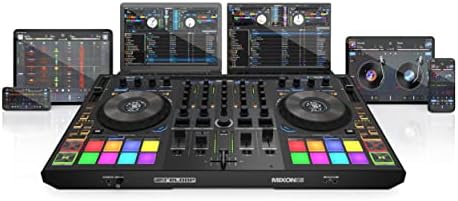
Best Four-Channel Pick: Reloop Mixon 8 Pro 4-Channel DJ Controller
Four channels is a workflow decision, not a status symbol. You buy the fourth channel when you are already running three sources and one of them is a vocal you refuse to let go of, or when your sets run long enough that you want a loop parked on one deck while the other two keep moving.
The Mixon 8 Pro is the four-channel pick here, and the reason is positioning. It sits between the phone-based starter and the standalone flagship, in the range where a working mobile DJ actually lives. Long wedding nights, a couple of mics, a house track held in reserve, a request you need to cue without killing the floor.
If you are honest with yourself and you only ever mix two decks at a time, you are paying for channels you will not touch, and that money buys better jog wheels somewhere else. Buy the fourth channel when you can name what goes on it.
How I Judge a Controller
Every controller gets the same four questions from me, and none of them appear on a spec sheet.
The first is the four-hour set. Not thirty minutes of messing around. A real set with real transitions, at gig volume, until the point where you stop thinking about the gear and start thinking about the room. Gear that only works for the first hour is gear that fails in hour three.
The second is the jog wheel with your eyes closed. Feel beats specs. A platter with no resistance makes every pitch bend feel like a guess, and cheap plastic wheels make every mix feel like a mistake. You cannot test this in a store aisle with music playing. You test it by closing your eyes and moving the platter a millimeter.
The third is the fader. Faders die, and the question is not whether but when. A crossfader that has already gone soft in the first month is a crossfader that will betray you during a cut.
The fourth is the software bundle. This is the one people skip, and it is half the value of the purchase. A controller is only as good as what it ships with, and a bundle that wants a subscription for basic features is a bill disguised as a gift. Check what you get before you check the hardware.
What Actually Separates These Four
Strip away the marketing and these four differ on three axes.
The first is where the music comes from. The RANE SYSTEM ONE is standalone, which means the machine is the setup. The other three assume a phone or a laptop is doing part of the work. That single decision changes your failure modes: a standalone rig fails when the unit fails, and a tethered rig fails when the cable, the port, or the operating system decides to have an evening.
The second is channel count and how you use it. The Hercules DJControl Mix gives you two decks and forces you to learn transitions. The Reloop Mixon 8 Pro gives you four and expects you to have opinions about what goes on them. More channels do not make you better. They make a more complicated night possible.
The third is feel, and feel does not scale with price in a straight line. The best-feeling controller in a store is sometimes the one nobody is looking at. Close your eyes, touch the platter, and trust your hands over the display.
The DJ controller comparison table
This is the shortlist in one place. Match the job to the row, not the row to your budget, and you will end up with the right box.
| Controller | Best for | Format | Price |
|---|---|---|---|
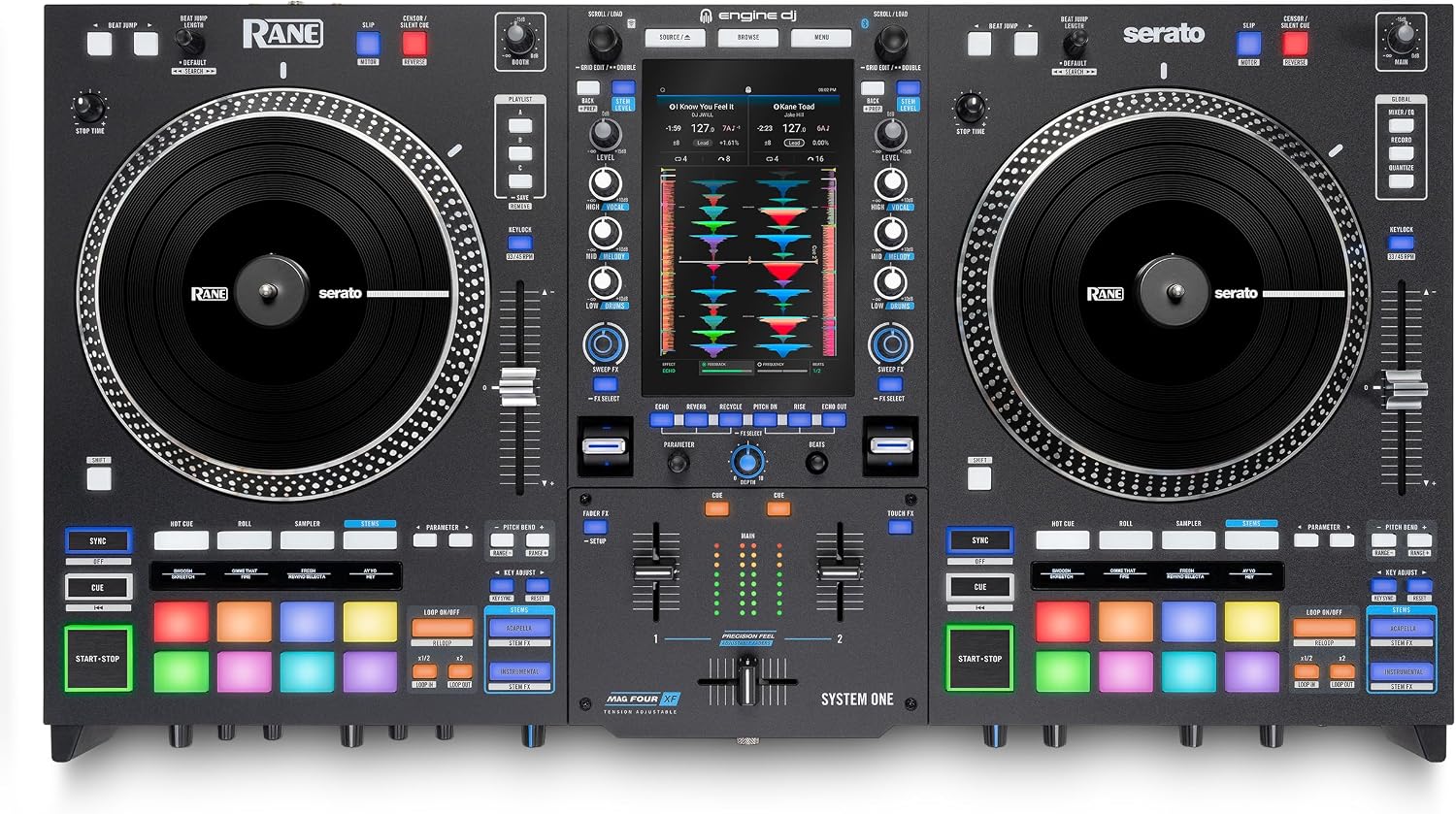 Visit on Amazon → Visit on Amazon →RANE SYSTEM ONE Motorized Standalone DJ Controller |
Club, wedding, and touring sets where you want no laptop in the chain | Standalone with motorized platters | $2,499.00 |
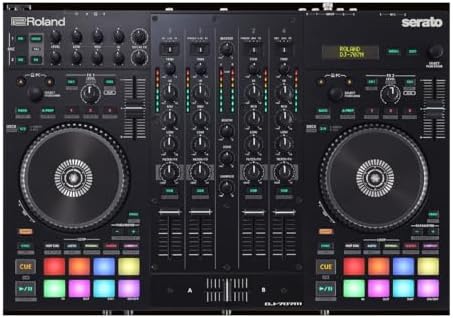 Visit on Amazon → Visit on Amazon →Roland DJ-707M DJ Controller for live streamers and content creators |
Streaming rooms, content setups, and anyone mixing while talking on camera | Controller built for live streamers and creators | $1,139.99 |
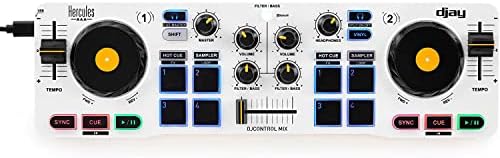 Visit on Amazon → Visit on Amazon →Hercules DJControl Mix Bluetooth Wireless DJ Controller for Smartphones |
First controller, nightly practice, phone-based setups | Two decks, Bluetooth wireless, dJay app | $127.69 |
 Visit on Amazon → Visit on Amazon →Reloop Mixon 8 Pro 4-Channel DJ Controller |
Long mobile sets and DJs already running three sources | Four-channel controller | $1,099.99 |
Do you need four channels?
Most people do not, and most people buy them anyway. Four channels earn their place when you can name the fourth source before you buy. A vocal you are holding, a loop you do not want to lose, a second mic for a toast, a track you are cueing for the next hour. If you cannot name it, you are buying headroom for an imaginary version of yourself.
Standalone or laptop-tethered?
Standalone means fewer things to break and more money up front. Tethered means more flexibility, more software choices, and a laptop that will eventually update itself at the worst possible moment. There is no universally right answer, only the failure mode you would rather live with at 1 a.m.
Should you buy the RANE SYSTEM ONE?
Yes, if your gigs are the job and you want the laptop out of the chain. Standalone plus motorized platters is a specific combination, and it is the combination that makes a booth feel like an instrument instead of a computer with a keyboard glued on. If you came from turntables and your hands never quite trusted a static jog wheel, this is the box that ends that argument.
It is heavy, it is expensive, and a beginner should not start here. For a working DJ who plays twice a week, the question is not whether it costs more. It is whether it costs less than a laptop that fails in front of four hundred people.
Should you buy the Roland DJ-707M?
Yes, if streaming is part of the job rather than an afterthought. It is built for live streamers and content creators, which means the layout assumes you are running a show and a mix at the same time. If your income comes from an audience watching you work, that assumption is worth more than any single spec.
If you only play clubs, buy for the club instead. Nobody in a dark room has ever cared what your controller was designed for, only whether the transitions land.
Should you buy the Hercules DJControl Mix?
Yes, if you are starting out, and especially if you are starting out broke. Bluetooth wireless, iOS and Android, the dJay app, two decks. It gets you practicing tonight instead of researching for three more months.
The best controller is the one you actually turn on, and this is the one you can turn on in a bedroom, a dorm, or a kitchen table without a single cable negotiation. Buy it, play on it every night, and upgrade when your transitions, not your ambitions, tell you to.
Should you buy the Reloop Mixon 8 Pro?
Yes, if four channels is a workflow need you can already describe. It is the middle path between a phone starter and a standalone flagship, and it is aimed at the working mobile DJ who needs mics, decks, and a reserve track all live at once.
If you cannot name what goes on channel four, save the money and buy better jog wheels on a two-channel controller. You will mix better, and you will not miss what you never used.